AML in Uzbekistan: turning a transaction alert into a defensible decision
How an Uzbek bank can separate an AML alert from a suspicious-transaction decision, preserve evidence and control disclosure.


When a monitoring rule fires, the bank has an alert, and nothing more yet. An amount, route, counterparty or behaviour differs from the expected profile. Someone then has to assemble context, test a lawful explanation and record an authorised conclusion. If every alert is treated as a legal finding, the queue fills with noise. If alerts are closed without evidence, real risk drops out of sight.
For commercial banks, the operating framework is set by Uzbekistan's Internal Control Rules registered as No. 2886, whose consolidated text includes amendments effective in 2026. This article covers banks only. A payment organisation, securities firm or other reporting entity has its own current sector rules and should work from those instead of copying the bank workflow.
In brief
AML is a governed decision system; a sanctions-list lookup is one input to it.
An alert opens an investigation. By itself it proves no money laundering and does not make a transaction legally suspicious.
Customer profile, ownership, counterparties, purpose and movement of funds provide the context for analysis.
Screening and transaction monitoring answer different questions, so keep them as separate evidence objects.
The report, the reason for it and later actions must be recorded without tipping off the customer.
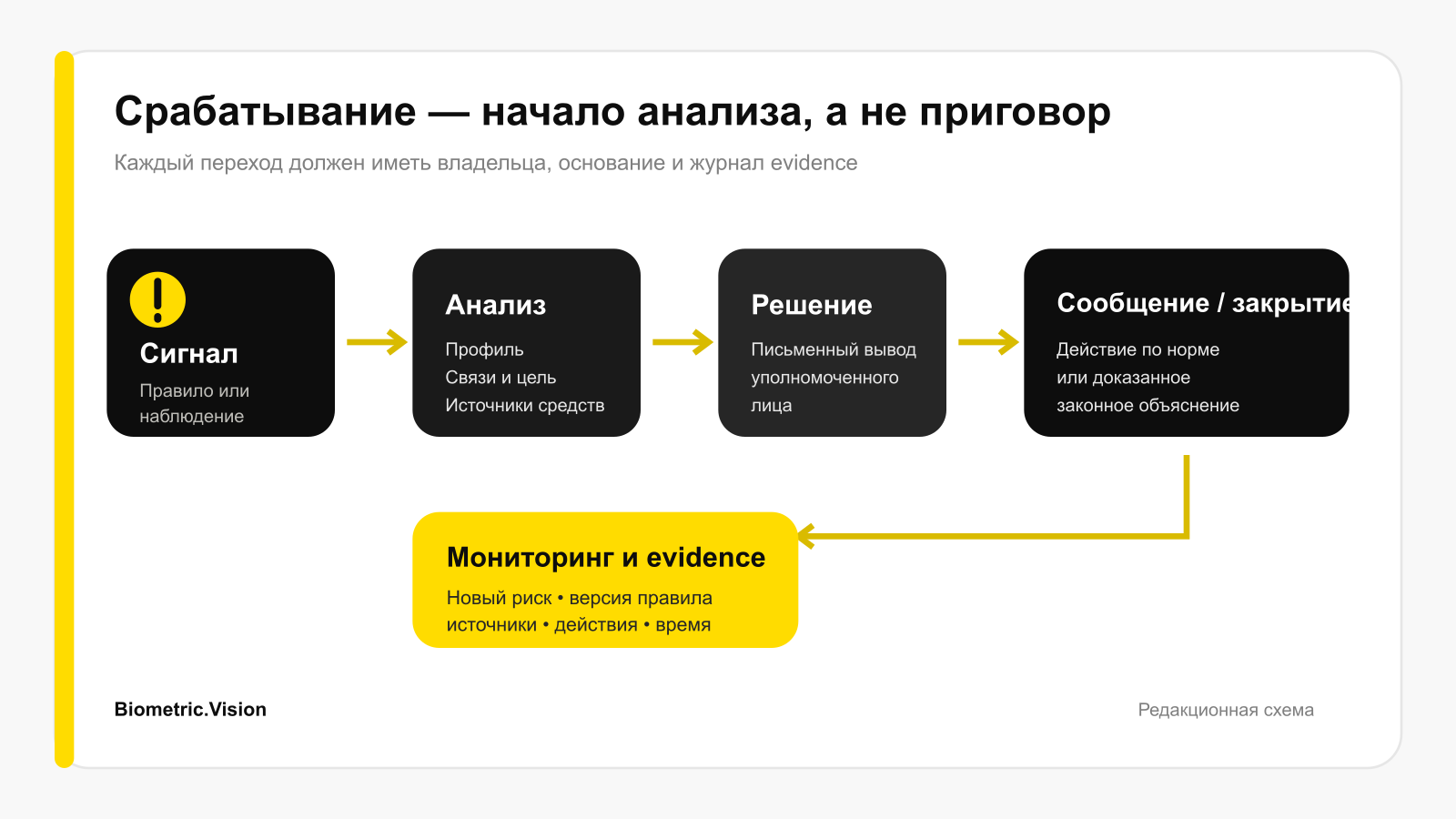
One case, five auditable states
State | What is known | Required control |
|---|---|---|
Alert | A rule detected a defined deviation | Attach the rule version and gather linked activity |
Analysis | Customer, counterparties, purpose and sources were examined | Test the risk hypothesis and a lawful alternative |
Decision | An authorised person recorded a conclusion | Close with reasons or classify and report |
Response | Required measures were executed | Reassess risk and monitoring parameters |
Evidence | Data, actions, people and time are linked | Make the case reproducible for audit |
Keep the transitions between states, because a final label hides them. closed tells an auditor nothing about what was checked. suspicious leaves out who decided, which evidence supported the conclusion and what happened next.
Internal control is an architecture, not one department
The Rules No. 2886 describe internal control as a combination of organisational structure, methods and procedures. The dedicated Internal Control Service runs that system. Customer-facing, operations and technology teams still create and handle much of the evidence.
The first line sees the customer and transaction, performs the assigned checks and escalates discrepancies. The Internal Control Service studies the file, documents the classification and handles the required interaction with the specially authorised state body. With this split, a commercial owner cannot quietly close an inconvenient case, and compliance never ends up reviewing its own operational actions.
Independence has to show up in access rights, reporting lines, incentives and incompatible-duty controls. An organisation chart proves little if analysts cannot reach source data, or if someone can overwrite their decisions without leaving an audit event.
An alert and a suspicious transaction are different legal states
The current rules distinguish a transaction that raises concern before the final classification from a transaction for which internal control has developed a substantiated suspicion relating to laundering, terrorist financing or proliferation financing. In day-to-day work the difference looks like this:
the detection rule and observed indicator are attached to the alert;
the analyst receives linked transactions and the current customer profile;
documents, participants, business purpose and flow of funds are examined;
the customer's explanation is tested against independent information;
the head of the Internal Control Service records the required written decision where grounds exist;
the decision starts reporting and follow-up measures, or produces a reasoned closure.
The rules require a full analysis before classification. Automation can find a deviation and prepare the evidence. It cannot tell you what an unusual payment means economically without the context around it.
A threshold starts analysis; it does not prove wrongdoing
Rules may use quantitative criteria and aggregation logic for particular operations. Those parameters can change with each regulatory edition and calculation basis. Keep them versioned and visible, outside the source code.
Each detection rule needs its own control card:
legal or policy basis;
unit, formula and aggregation period;
linked-transaction logic;
exclusions and scope;
effective-from and effective-to dates;
configuration owner and test evidence;
escalation route and permitted outcomes.
With the card, an auditor can go past “What is the threshold today?” and ask the question that matters: did the bank apply the correct rule to the correct population at the time of the transaction?
Analysis should expose the causal chain
A good case note tests a risk hypothesis instead of retelling the payment. It works through the customer profile, economic purpose, parties and links, source of funds, sequence of events and plausible lawful explanation.
Field | Evidence expected |
|---|---|
Alert | Triggered rule and observable deviation |
Facts | Amounts, dates, accounts, devices and counterparties |
Sources | KYC file, documents, registers and customer responses |
Discrepancies | What conflicts with the expected profile |
Hypothesis | How the pattern could relate to an AML risk |
Counter-hypothesis | Which lawful explanation was tested |
Decision | Closure, enhanced review, restriction or report |
The KYC in Uzbekistan guide explains how to build the starting profile. Without that profile, monitoring falls back on amount and frequency and loses sight of the customer's activity, ownership and expected behaviour.
Screening is not transaction monitoring
Biometric.Vision AML Screening can check people and organisations against the stated sanctions, PEP and other sources, support repeat monitoring and retain the result. It asks whether a risk source may be linked to an identity.
Transaction monitoring asks whether activity fits the profile and applicable rules. A name candidate says nothing about a transaction, and an unusual transaction may have no connection to any listed person. Put the two results in one case only after you have a defensible link between the subject, the source record and the transaction.
Non-disclosure changes the customer-contact design
The current rules restrict disclosure to legal and natural persons that information about their transactions has been sent to the authorised body. You can still ask the customer for supporting documents. The request has to get the context you need without revealing the internal classification or the fact of a report.
Free-form comments from frontline staff are where this usually goes wrong. An employee can name the detection rule by accident or confirm that a report was made. Approved templates, role-based access and training belong to the control for that reason.
An amendment effective on 9 August 2026 adds a narrower branch. Where suspicions exist and performing customer due diligence would disclose relevant information to the customer, the bank may refrain from that due diligence and must submit a suspicious-transaction report. The bank still cannot drop KYC at will. The branch needs a restricted workflow, Internal Control Service oversight and a documented reason each time it is used.
Closing an alert is also a decision
Plenty of alerts turn out to have a lawful explanation. That is fine as long as someone else could reproduce the closure. The case should state which evidence defeated the risk hypothesis, who checked it and whether a repeat event would be treated in the same way.
“Known customer”, “no previous problems” and “small amount” are weak closure reasons. A defensible closure links the observed deviation to verified contracts, profile data, source of funds and economic logic. Depending on the result, the bank may retain the risk rating, update the profile, apply enhanced review, restrict a relationship where the rules require it, or report and take follow-up measures.
Evidence must outlive the analyst and the interface
Screenshots prove very little about an internal-control process. Investigation and audit need machine-readable links among the customer, transaction, rule version, sources, actions, decision and follow-up.
Biometric.Vision Orchestrator can connect KYC, screening and manual-review steps in a versioned workflow. The minimum case ledger contains the original alert, rule version, linked-transaction sample, sources, requests and responses, authorised decision, reporting event in the applicable format and later risk change. The bank remains responsible for legal classification, reporting and restrictions.
From 9 August 2026, the Rules expressly provide that the special reporting log is maintained electronically in the bank's automated information systems. A defensible implementation links report ID, time, author, basis, transmission status and later actions without reconstructing the timeline from email.
Judge an AML system by what happens after the alert: whether it catches a meaningful deviation, supports an independent analysis and timely action, and lets the bank reconstruct the decision years later from the record.
Sources
Ready to strengthen your customer checks?
500 checks free every month · no card · no contract · no sales call.