Beneficial owner in Tunisia: how to evidence ownership and control
A practical Tunisia UBO workflow covering the 20% test, indirect ownership, other control, senior-manager fallback and defensible KYC evidence.


A registry extract may identify every immediate shareholder and still fail to reveal who ultimately controls the company. Holding entities, voting arrangements and de facto influence can sit between the customer and the relevant natural person. In digital KYC, identity and document verification cannot repair an unresolved ownership chain. The UBO field should hold the result of a documented analysis instead of a line copied from the first corporate document.
Tunisia’s Law No. 2018-52 on the National Register of Enterprises defines the beneficial owner by ultimate ownership or effective direct or indirect control. Government Decree No. 2019-54 turns that definition into an ordered set of tests. Reviewers have to follow that order and keep evidence for each step.
The answer in brief
The 20% capital or voting-rights threshold is the first of several tests.
Direct and indirect interests must be traced through the chain to natural persons.
If the ownership test does not produce a reliable answer, control through other legal or factual means must be examined.
The principal manager is a fallback once the earlier tests fail. A director is not automatically a UBO.
An RNE declaration shows what was declared. Someone still has to verify it.
AML screening follows identity resolution; it cannot discover an undisclosed owner behind a holding structure by itself.
Three tests that should not be rearranged
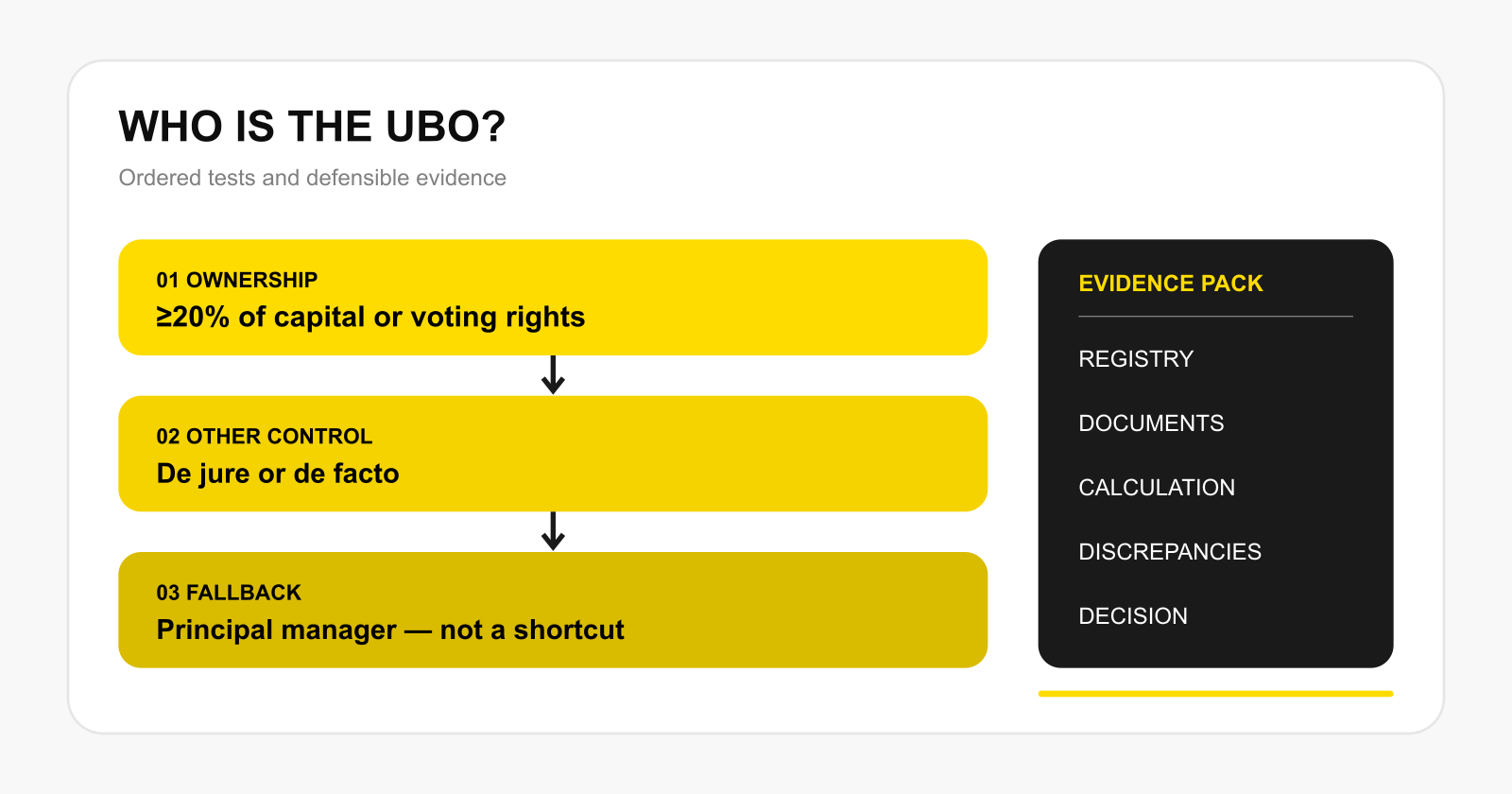
The first test identifies natural persons who directly or indirectly hold at least 20% of capital or voting rights. An indirect holding requires the reviewer to traverse each intermediate entity rather than stop at a corporate shareholder’s name.
Suppose a person owns 60% of HoldCo and HoldCo owns 40% of the operating company. The editorial economic-interest calculation is 60% × 40% = 24%. That helps test the statutory 20% threshold, but it does not settle control. Enhanced voting rights, shareholder agreements, nominee relationships and vetoes require a separate review.
The second test matters where doubt remains under the first test or no natural person is identified by it. The reviewer looks for a natural person exercising de facto or de jure control over management, administration, the general meeting or the functioning of the entity. The largest economic interest and effective control may belong to different people.
The third test identifies the natural person holding the position of principal manager when the earlier criteria do not yield a beneficial owner. The case file should show which earlier tests were completed, why they failed and why the named individual fits the fallback. Without that record, a reviewer can use a narrow exception to skip the ownership research.
Roles that are not automatically equivalent
A legal representative signs for the company. A shareholder holds an interest or voting rights. A director manages within assigned powers. A beneficial owner is the ultimate natural person identified under the applicable test. One person may occupy several roles, but a title alone does not prove the UBO conclusion.
For legal arrangements, the decree addresses the settlor, trustee, protector where applicable, beneficiaries and any natural person who ultimately exercises effective control. A conventional cap table does not fit every such arrangement.
The RNE declaration is a starting point, not the conclusion
Law No. 2018-52 establishes a beneficial-owner sub-register and links company registration to a list of beneficial owners. Registration forms capture enterprise, shareholder, manager and UBO information, with the declarant attesting to its accuracy.
The official RNE UBO declaration checklist and form request enterprise and individual details and copies of identity documents for the legal representative and beneficial owner. This evidences a declaration associated with specified identities. It does not automatically prove that undisclosed agreements are absent or that the ownership chain remains current on the review date.
Keep declared and verified as separate states. The former records what the registry or customer says. The latter records the independent material reviewed, discrepancies resolved and reviewer who approved the conclusion.
A defensible evidence pack
Layer | Minimum evidence | Question answered |
|---|---|---|
Registry | current extract and UBO declaration | Which entity and persons were declared, and when? |
Corporate records | articles, member register, resolutions, structure | Who holds capital, votes and special classes? |
Chain | records for each intermediary | Does the path reach natural persons? |
Control | agreements, veto rights, mandates, nominee or trust records | Who controls beyond percentage ownership? |
Identity | valid ID, transliterations and birth data | Is the natural person uniquely resolved? |
Decision | calculation, selected test, exceptions and reviewer | Can another reviewer reproduce the result? |
Documents should attach to nodes and relationships in the structure rather than sit in an undifferentiated archive. For every relationship, record the legal right, capital share, voting share, source and date. A changed node can then trigger recalculation of all dependent conclusions.
Treat contradictions as cases, not formatting errors
A conflict between an RNE declaration, articles and the customer’s explanation should stop straight-through approval. Preserve both versions, identify the disputed relationship and require an explanation or an updated authoritative document. Silently overwriting one source destroys the audit trail.
Changes in ownership, voting rights, governance, vetoes, trust roles or identity documents should trigger renewed analysis. Periodic reviews help, but event-driven review often matters more. A fresh extract does not update an old control diagram by itself.
What technology can support—and what still requires judgment
Biometric.Vision Document Verification can support the capture and analysis of identity or corporate documents. It does not come with direct RNE access, and document analysis alone cannot establish a complete control structure. Integration and document coverage must be confirmed for the specific deployment.
Once the natural persons have been resolved, Biometric.Vision AML Screening can screen them against stated sanctions, PEP and other lists, support ongoing monitoring and record the outcome. Screening will not find an unknown owner hidden behind an entity chain. A name hit is also only a candidate until birth date, nationality and other identifiers confirm or rule out the match.
UBO analysis is one control inside customer due diligence. The company, the representative’s authority, the relationship purpose and any sector-specific duties still need their own verification.
Pre-decision checklist
the chain reaches natural persons, including through foreign intermediaries;
capital and voting rights have been calculated separately;
contractual and de facto control have been assessed;
principal-manager fallback is reasoned rather than selected by default;
the RNE declaration has been compared with independent corporate evidence;
UBO identifiers are normalized before AML screening;
every discrepancy has an owner, status and closure evidence;
the source date and structure version make the conclusion reproducible.
A reliable UBO result consists of a versioned structure, its sources, the calculations and a reasoned choice of test, enough for a second reviewer to reach the same result. Sectoral AML rules and internal risk policies may require additional controls; Tunisian counsel should validate the procedure before publication or deployment.
Sources
Ready to strengthen your customer checks?
500 checks free every month · no card · no contract · no sales call.