Best Age Verification Software: How to Choose the Right System
Compare age verification software by method, accuracy, fallback, fraud controls, privacy and integration. Includes a practical pilot checklist.


The largest accuracy number on a vendor's homepage tells you little about the best age verification software for your service. You need a system that makes the right decision at your age threshold, resists predictable bypass attempts, treats different user groups fairly and sends uncertain cases to a stronger check.
Facial age estimation produces an estimate of age. It cannot give you a date of birth. In its first large evaluation of this technology, the US National Institute of Standards and Technology tested six algorithms on about eleven million operational photographs. NIST found that no algorithm clearly outperformed the others in every condition. Facial expression and glasses also changed estimates for the same person. NIST published the evaluation in May 2024.
Start your shortlist from the access decision and work backwards. Define the threshold, the acceptable error on each side, the fallback for an uncertain result and the evidence that must remain after the check.
Age estimation and age verification answer different questions
Age estimation analyses a selfie and returns an estimated age, age band or over/under-threshold result. It can minimise the data a user shares because the service may not need a name, document number or exact date of birth.
Age verification checks stronger evidence of age. A typical document route reads the date of birth, checks the document and binds it to the person presenting it. A reusable digital identity can disclose an age attribute without transmitting the underlying document again.
Age inference is different again. It predicts age from account history, behaviour or other signals collected after a person has used a service. Ofcom's current UK guidance lists facial age estimation, photo-ID matching and digital identity services among methods capable of being highly effective. It does not consider self-declaration capable of meeting that standard. Ofcom explains the method distinction in its implementation guide.
The methods are not interchangeable. A document route gives stronger evidence of an exact date but collects more personal data and can exclude people without an accepted document. A selfie route creates less friction, but a result close to the threshold needs a policy for uncertainty. Good software supports that policy instead of hiding it behind one pass/fail response.
Six tests for an age verification software shortlist
Ofcom assesses highly effective age assurance through four properties: technical accuracy, robustness, reliability and fairness. Its guidance also asks services to consider privacy and accessibility when choosing a process. Add NIST's findings, and you get six practical procurement tests.
Test | Evidence to request | Weak answer |
|---|---|---|
Threshold accuracy | False-adult and false-child rates at the age limits you use | One average error across all ages |
Robustness | Tests against printed photos, replay, masks and injected media | “AI-powered fraud protection” without a protocol |
Reliability | Repeatability, monitoring and incident response | A laboratory result with no production controls |
Fairness | Error results by relevant age and demographic groups | A diverse-training-data claim without outcomes |
Fallback | A route from uncertain selfie results to a document or reusable credential | Automatic denial or an unreviewed retry loop |
Data governance | Data fields, location, retention, deletion and processor terms | “Privacy-first” without a data-flow description |
The first row needs two error measures. A false-adult result admits a person below the threshold. A false-child result blocks an eligible adult. The acceptable balance depends on the service: access to adult content, sale of alcohol and an age-tailored social feature do not carry the same consequence.
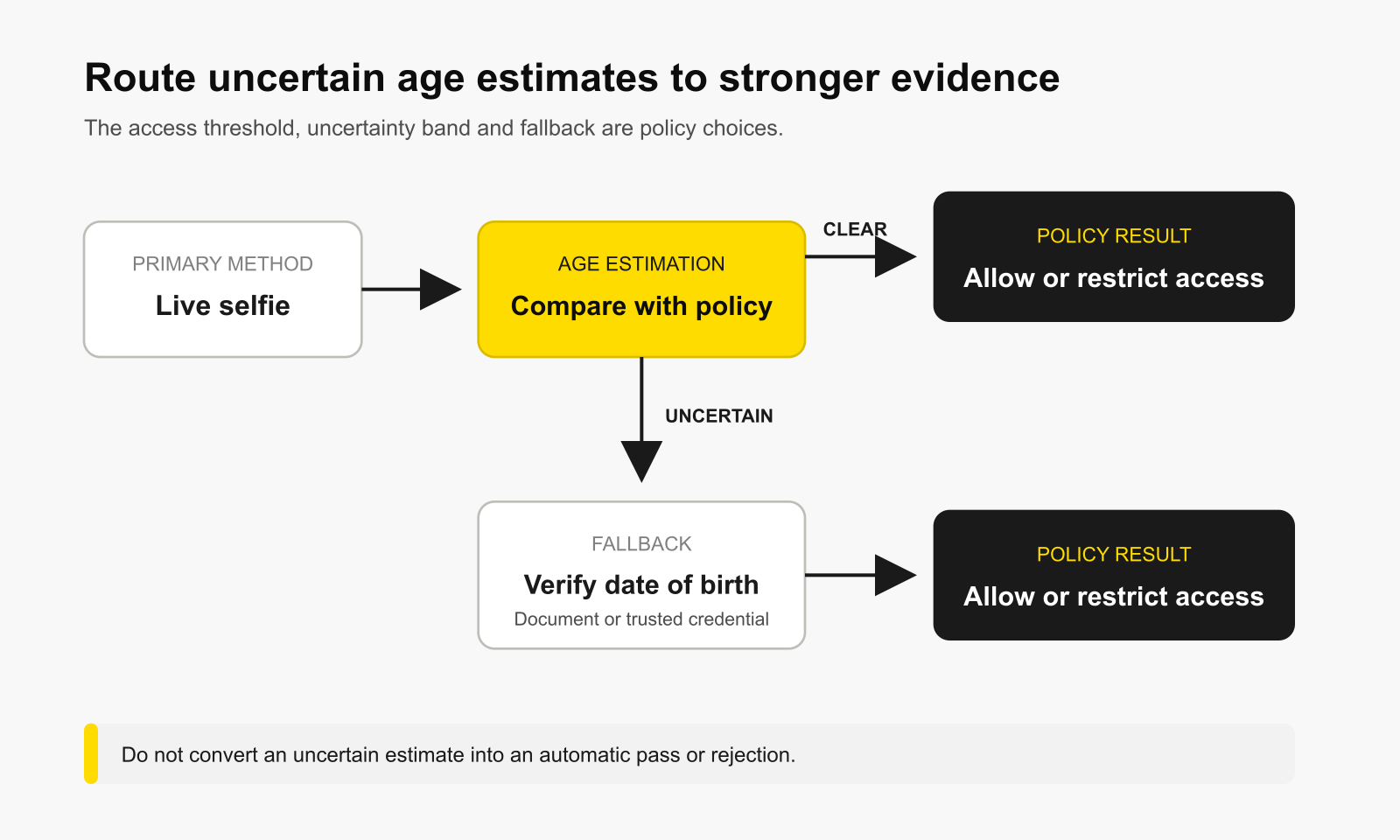
Ofcom recommends a challenge-age approach when a process uses estimation. The service sets the estimation threshold above the legal or product threshold, creating a buffer for model error. Users who fall inside the uncertain band move to another method. The regulator's guide describes this under technical accuracy.
Compare the complete decision route
Vendor pages show why the route matters. Yoti describes a portfolio that includes facial estimation, identity documents, reusable digital identity and other checks in one integration. Veriff describes a waterfall in which selfie estimation provides the first route and full identity verification handles higher-risk or uncertain cases. Both are product descriptions. Neither is independent proof that the service meets every buyer's threshold or jurisdictional duty. Yoti documents its available methods, while Veriff describes its age-assurance flow.
Method | User supplies | Best fit | Main purchasing question |
|---|---|---|---|
Facial age estimation | Live selfie | Low-data first pass | What happens near the threshold? |
Document age verification | Identity document, usually a selfie | Exact date or stronger evidence | Which documents and fraud checks are supported? |
Reusable age credential | Previously verified attribute | Returning users and repeat checks | Who issued it and how is revocation handled? |
Database or network check | Personal identifiers | Markets with reliable sources | What source supplies the age signal? |
Self-declaration | Entered date of birth | UX routing only | It should not be treated as strong proof |
No method wins in every case. The table shows what evidence a vendor has to provide for your use case.
Run a threshold-specific pilot
A sales demonstration rarely tests the difficult part of the flow. The pilot should reproduce the actual decision and include people close to the threshold.
Define the two costly errors. Record the impact of admitting an underage user and rejecting an eligible adult separately.
Freeze the decision policy. Set the access age, challenge age, retry limit and fallback before comparing results.
Build a representative sample. Cover the age bands, devices, lighting conditions and user populations expected in production.
Test attacks as a separate set. Printed images, screen replays and injected media should not be mixed into genuine-user completion rates.
Measure the whole funnel. Track completed checks, uncertain results, fallback completion, false decisions and time to decision.
Repeat selected checks. A reliability test checks that the same evidence produces a stable result. A plausible first result proves little.
Inspect the evidence trail. Confirm which result, method, policy version and timestamps remain available for an audit or user appeal.
NIST's report distinguishes age estimation from face recognition and evaluates performance across datasets and demographic groups. It does not certify a complete commercial service, its liveness controls or its compliance with a specific law. The full NISTIR 8525 report states that evaluation boundary.
Where biometric.vision fits
biometric.vision Age Verification combines two routes: AI estimates age from a selfie, while optical character recognition reads the date of birth from an identity document. The customer sets the minimum-age threshold in the dashboard and can integrate the flow through REST API, Web SDK or Mobile SDK. The public product page also describes cloud and on-premise deployment.
That combination fits a waterfall design: use a selfie when an age band is sufficient, then request a document when the policy requires an exact date or the estimate falls into an uncertainty band. The service can return the technical result, but the customer still owns the access rule, legal basis, retention policy and treatment of appeals.
The public page does not publish threshold-level error rates for every demographic group or establish compliance in every jurisdiction. Buyers should request those results for their intended threshold and validate them during the pilot. They should apply the same requirement to every shortlisted provider.
The buying decision
Choose age verification software only after the vendor has mapped its evidence to each of the six tests in the table above. A product that performs well on genuine adult selfies can still fail your business requirement if children can bypass it, eligible adults have no fallback or the audit record cannot explain a decision.
Start the procurement process with one page: the age threshold, challenge age, allowed methods, fallback, retained evidence and acceptance metrics. Use that page as the common test for every vendor, so a polished demo does not stand in for a production decision.
Ready to strengthen your customer checks?
500 free checks a month for a year · no card · no contract · no sales call.