KYC in Nigeria: Verification Requirements for Digital Onboarding
How Nigerian financial institutions can connect NIN or BVN retrieval, identity verification, CDD, screening and an auditable onboarding decision.


A valid NIN or BVN identifies a record in a national or banking identity system. That is where the customer decision starts. The identifier alone does not show that the current applicant controls the identity, why the account is being opened, who owns a company in the end or whether a sanctions candidate is a real hit. Digital KYC breaks down when teams read the identifier as the verdict instead of the first link in a chain of evidence.
The Central Bank of Nigeria Customer Due Diligence Regulations, 2023 require covered financial institutions to identify and verify customers, signatories, directors and beneficial owners, understand the nature and purpose of the relationship, apply risk-based and enhanced measures, conduct ongoing due diligence and keep records. CBN's BVN overview also records the 2023 direction that onboarding begin by electronically retrieving BVN- or NIN-related information from the relevant databases for individual accounts and wallets within scope.
In brief
NIN and BVN are identity anchors that come from different institutions. CDD still has to be done around them.
Retrieve authoritative data electronically where the applicable CBN rule requires it, then bind the response to the current applicant.
Separate identity mismatch, biometric failure, screening candidate and infrastructure outage.
Retain a decision graph showing sources, evidence, policy version, escalation and final authority.
NIN, BVN and a customer profile are not interchangeable
Object | Primary role | What it does not settle |
|---|---|---|
NIN | Foundational national identity reference administered by NIMC | Banking history, account purpose or financial risk |
BVN | Unique banking-system identity linked to biometric enrolment | Current NIN status, beneficial ownership or transaction purpose |
Customer profile | Institution's current CDD record and risk view | Authoritative identity unless supported by verified sources |
NIMC launched NINAuth as a consent-based verification channel in 2025. The launch notice calls it the exclusive mandatory NIN channel for federal ministries, departments and agencies. Do not stretch that into the same mandate for every private business. Separately, the NIMC Act 2026 identifies NIN as Nigeria's foundational identity credential. A financial institution should confirm which channel and approved-partner arrangement apply to its commercial use case. Holding a NIN number or slip is not live verification.
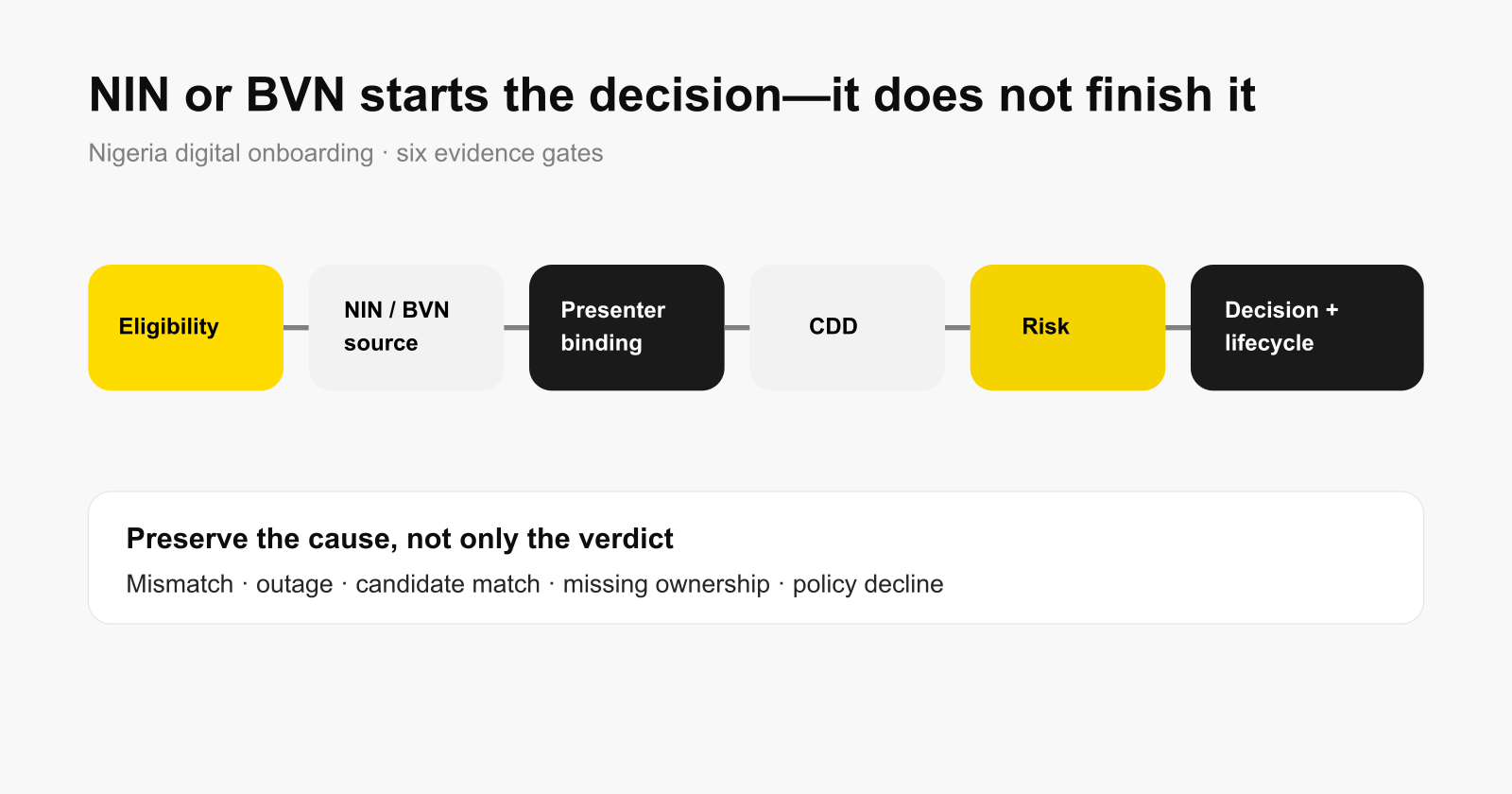
A six-gate onboarding architecture
Gate 1: eligibility and customer type
First work out whether the applicant is an individual, a legal person, a representative or a beneficial owner, then pick the product and the applicable tier. Do this before you ask for any data, so the evidence package matches the regulatory scope.
Gate 2: authoritative identity retrieval
Retrieve NIN- or BVN-related information through the authorised route required for that account or wallet. Store the source response and transaction reference apart from what the applicant typed in, and flag mismatches instead of overwriting them.
Gate 3: presenter binding
Bind the current applicant to the trusted portrait or identity record. Face comparison answers a similarity question at a configured threshold, and liveness covers the presentation attacks it was tested against. Neither tells you the purpose of the account or whether the person may act for a company.
Gate 4: CDD and beneficial ownership
Collect occupation or business activity, purpose, expected transactions, source-of-funds context and representation data. For legal persons, identify and verify directors, signatories and beneficial owners as required, and follow ownership and control all the way up instead of stopping at the first registered company.
Gate 5: screening and risk rating
Screen the verified identity and the relevant connected persons. A name match goes to adjudication; it proves nothing yet. Feed product, geography, channel, ownership, behaviour and PEP/sanctions context into the institution's documented risk model.
Gate 6: decision and lifecycle
Approve, add conditions, escalate or decline, and record the reason and policy version each time. Set refresh events and ongoing monitoring, since a customer onboarded with the correct identity can become higher risk later.
Decision states should preserve the cause
identity source confirmed + presenter bound + CDD complete + risk acceptable
→ approve under stated controls

identity source confirmed + biometric result borderline
→ controlled retry or review

source unavailable
→ pending / contingency route, not “fraud”

screening candidate unresolved or beneficial ownership incomplete
→ compliance escalation before activation
The CBN Regulations deal with cases where CDD cannot be completed and with the timing of verification. Map each product restriction or escalation to those rules and to the institution's approved policy. The regulatory consequence is not a technical vendor's call.
Evidence that survives audit and dispute
For every decision, link:
customer type, product and tier;
submitted values and authoritative values;
NIN/BVN source, request reference and timestamp;
biometric capture, liveness and comparison results;
beneficial-owner and representative evidence;
screening candidates and adjudication notes;
risk factors, score and rule version;
manual actions, overrides and final approver;
review trigger and retention/deletion status.
Raw selfies make a poor permanent evidence layer. Signed source responses, hashes, derived outcomes and versioned policies can give you better provenance with less biometric exposure, subject to the applicable record-keeping rule.
Five procurement questions
Does the provider have an authorised route to the identity source, or only document OCR?
Are liveness, face comparison and source verification returned as separate results?
Can thresholds and exception routes be tested on the institution's customer population?
Can the system retain the inputs and policy version behind a verdict without excessive raw data?
Does the contract prohibit unapproved reuse and identify every subprocessor and hosting location?
Biometric.Vision can orchestrate document, liveness and face checks, and AML Screening can return sanctions and PEP candidates with monitoring history. Neither gives you access to NIMC or NIBSS sources. The CDD, beneficial-ownership and risk decisions stay with the institution.
Digital onboarding in Nigeria needs more than “NIN plus selfie”. You need a record you can reproduce, linking the authoritative identity, the applicant in front of you, the intended relationship and the institution that accepts the residual risk. Start procurement with the five questions above.
Ready to strengthen your customer checks?
500 checks free every month · no card · no contract · no sales call.