Virtual assets in Kyrgyzstan: regulation and customer checks
How virtual-asset services are regulated in Kyrgyzstan, what customer checks a provider performs, and what its bank examines.

Date checked: 29 October 2026.
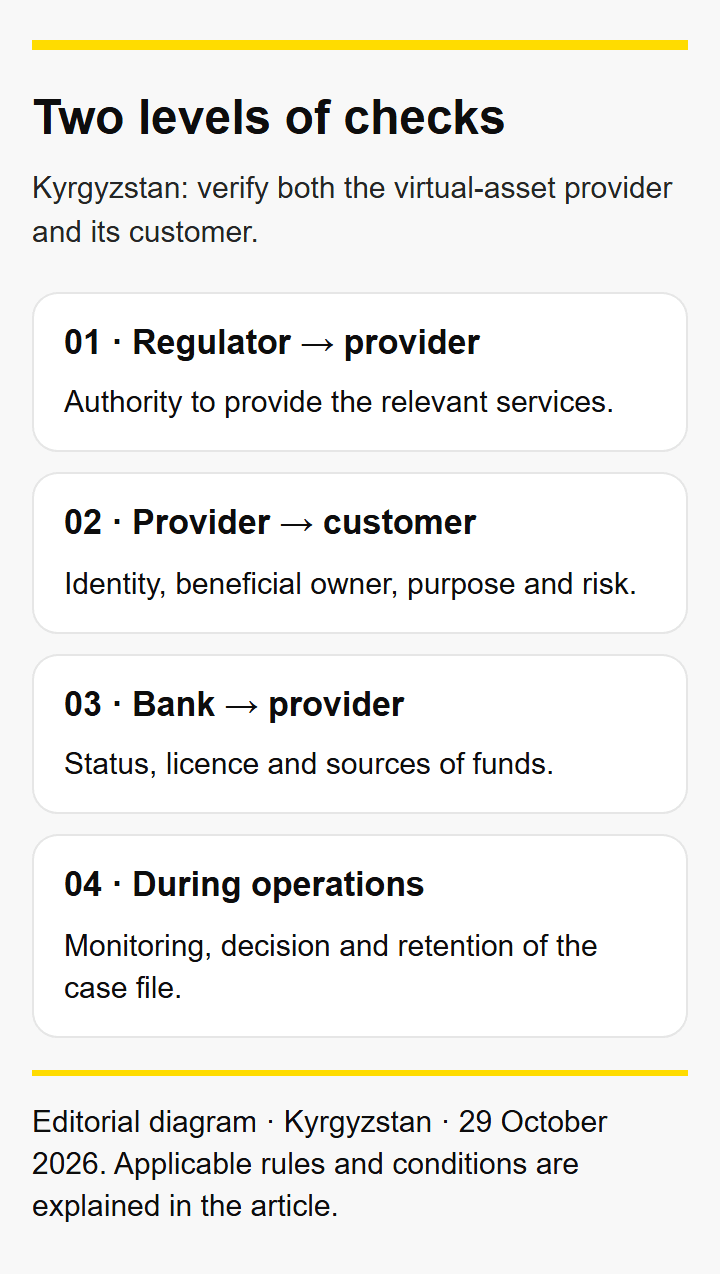
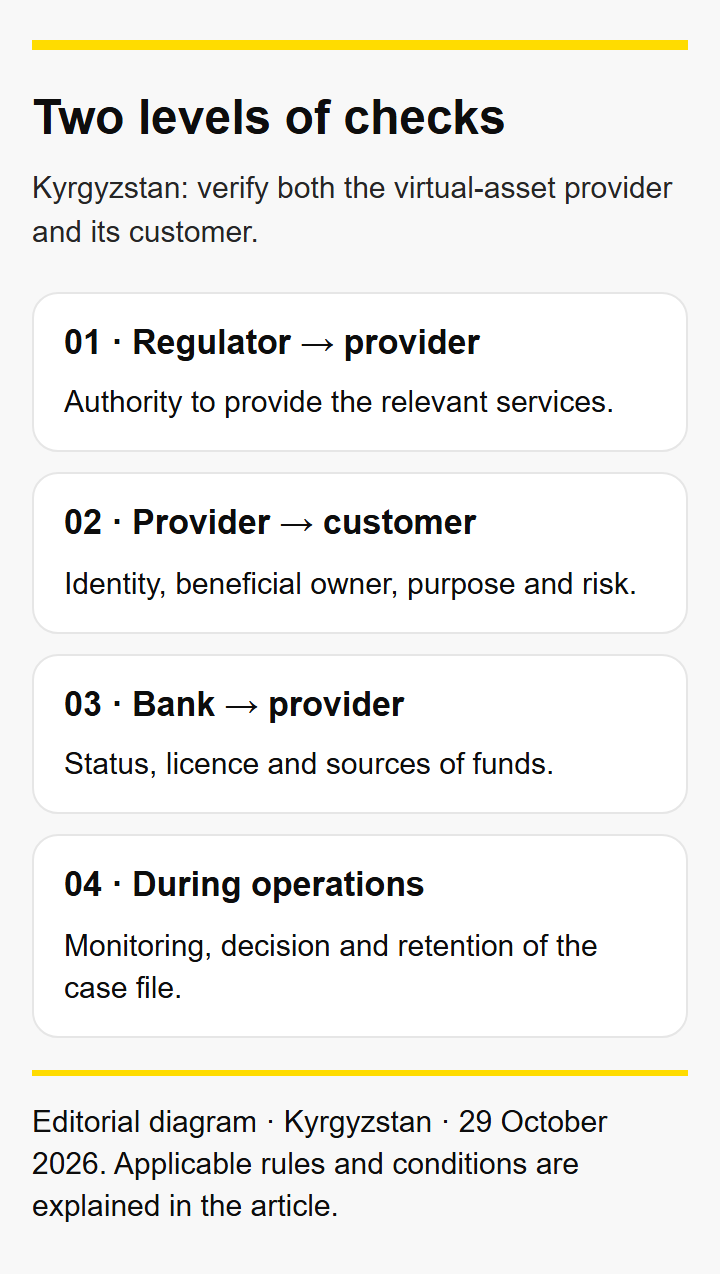
Virtual-asset service providers, including those working with cryptocurrency, are classified as financial institutions by article 5, part 1, paragraph 19, of Law No. 87. Customer checks by a crypto service therefore fall under the law on countering the financing of criminal activity and the legalization of criminal proceeds. A manager needs to define the services offered, understand the regulator’s licensing role, and organize work with customer data. The service’s bank performs its own checks as well.
Define the activity first
The government investment guide describes a service provider as a legal entity registered in the Kyrgyz Republic and operating under a licence. The main difference between an exchange service and a trading venue is what each does with the customer’s transaction:
Service | What it does | Who carries out the transaction |
|---|---|---|
Exchange operator | Buys, sells, and exchanges virtual assets in its own name | The exchange operator itself, as a legal entity |
Trading-platform operator | Provides an electronic venue on which transactions are concluded | The trading participants, who are the platform’s customers |
The guide also includes transfer, custody, management and control of virtual assets, and financial services connected with their placement. Mining and issuance are identified as other regulated activities. If a company combines activities, examine each separately during planning; one status does not necessarily explain everything it does. The guide does not classify a virtual asset as a means of payment.
Who regulates a service provider?
Licensing powers belong to the National Agency for Virtual Assets and Blockchain Technologies under the President of the Kyrgyz Republic (NAVA). Its regulation, associated with Presidential Decree No. 186 of 28 May 2026, assigns the agency responsibilities for state policy, rule-making, licensing and other permits, and enforcement measures (paragraph 3).
At the planning stage, match the service actually provided to its licensing regime. Registration proves a company exists; licensing concerns its right to carry out the activity. Check the service’s scope, the required permission, and the issuing authority’s powers together. Before approaching the regulator, describe what the company does in its own name, what it arranges for customers, and whether it will hold their assets.
How to check a customer and beneficial owner
A provider’s own customer due diligence (CDD) rests on articles 20 and 21 of Law No. 87. In the law’s terms, identification establishes identifying details; verification checks them. A beneficial owner may be the individual who ultimately owns or controls a customer, or the person in whose name or interests a transaction is made. These are separate questions from the start of data collection.
Under article 21, the provider identifies and verifies the customer, establishes the purpose and intended nature of the relationship, identifies the beneficial owner, and takes available reasonable measures to verify that person. Results are documented. Information about activity and financial position is retained and updated, while transactions are continually assessed against known information, source of funds, and risk. Where there is a representative, their identity and authority are checked separately. The customer must provide the information and documents needed for CDD.
Article 20 requires customer risk to be documented, classified, and updated, with proportionate measures. The provider must also submit information on identified risks to the relevant supervisory body and financial intelligence unit. The Cabinet of Ministers determines specific CDD cases and procedures; measures are set with regard to risk and the applicable subordinate rules.
What the bank checks about the crypto service
When a bank establishes a relationship with a virtual-asset counterparty, it follows its own National Bank of the Kyrgyz Republic (NBKR) requirements. Paragraph 28-3, as amended by NBKR Board Resolution No. 2026-P-14/44-1-(NPA) of 28 August 2026, requires reasonable, risk-proportionate measures to establish such a customer’s status. The check includes confirmation of a licence, registration, or other permission under applicable law, as well as analysis of the origin of virtual assets and sources of funds.
Insufficient information enters the risk assessment and may justify requesting further documents, applying additional controls, or taking other measures permitted by law. The example here concerns a bank customer that is a crypto service; paragraph 28-3 itself is not limited to corporate counterparties.
When preparing to speak to a bank, distinguish questions about the company’s status from questions about particular incoming funds. A document granting permission to operate does not explain where assets in a given transaction came from. That is why a bank may continue asking about funds and transaction patterns after checking the licence.
An operation involving elevated risk
Imagine a company requests an exchange of virtual assets. The service has information about its representative but lacks the necessary details on its beneficial owner and the relationship’s purpose. The example illustrates distinct grounds for decisions; it does not prescribe the same document pack for every customer.
First outcome. Required documents are not supplied. Article 21, part 5, of Law No. 87 obliges the provider to choose among not starting a relationship, suspending or ending an existing relationship, or not carrying out the transaction. This example chooses the last measure. The provider reports its decision to the financial intelligence unit within one working day after making it.
Second outcome. The documents arrive, but the transaction is then found suspicious under the prescribed procedure. Article 23 requires a report to the financial intelligence unit within five hours of that determination, regardless of amount. Attempts to carry out suspicious transactions must also be reported.
The difference lies in the grounds: missing information and a duly identified suspicion require different case records. Requesting more documents alone does not mean the transaction has been classified as suspicious. Record what was missing, which decision was made, and which event started the relevant deadline.
If a relationship or transaction takes place, article 22 governs retention. The customer file, including forms, correspondence, and document copies, is kept for at least five years after the relationship ends, the account closes, or a one-off transaction takes place. Information and documents on completed transactions, together with analytical conclusions, are kept for at least five years after completion of the transaction. The two clocks must not be conflated.
Originally published in Russian. Adapted for English readers.
This article is for information only and does not replace advice from a qualified lawyer.
Ready to strengthen your customer checks?
500 free checks a month for a year · no card · no contract · no sales call.