How Kazakhstan’s National Bank Anti-Fraud Centre works
How Kazakhstan’s Anti-Fraud Centre shares signals on fraudulent transactions, who makes blocking decisions, and what participants must do.


When a bank spots a suspicious transfer, it may have minutes or seconds to check its own signals, share the incident with other participants, and stop money moving further along the chain. Kazakhstan’s national Anti-Fraud Centre provides shared infrastructure for that response. It is not a “super-bank” that blocks accounts itself: financial institutions and law-enforcement bodies decide on incidents, and institutions lift restrictions on the basis of the relevant law-enforcement decisions.
The National Bank confirms this boundary. Overlooking it could cause a business to transfer responsibility for its own monitoring to a platform, leaving it unable to explain to a customer who restricted a transaction and why.
At a glance
The Anti-Fraud Centre is data-sharing infrastructure and a common incident database, not a remote office that blocks accounts.
Participants include banks, payment and microfinance organizations, credit bureaus, telecom operators, law-enforcement bodies, and other government agencies in defined roles.
A centre signal does not replace the financial institution’s investigation and decision.
By 1 January 2026, the centre had recorded 80,871 payment incidents and helped block KZT 2.8 billion in time.
The value of integration lies in the speed and reproducibility of a participant’s response, not the number of fields it sends.
What the shared system does
In August 2024, the National Bank announced the production launch of its fraudulent-transaction information exchange. Its stated functions are to enable financial institutions to detect and block fraudulent transactions, respond quickly, share information in real time, and maintain a common database.
The current rules for operating the centre were approved by National Bank Board Resolution No. 54 of 25 August 2025. They define roles and exchange procedures. The centre connects participants and stores specified data; responsibility for an appropriate response remains distributed.
In practice, view the flow as five separate events:
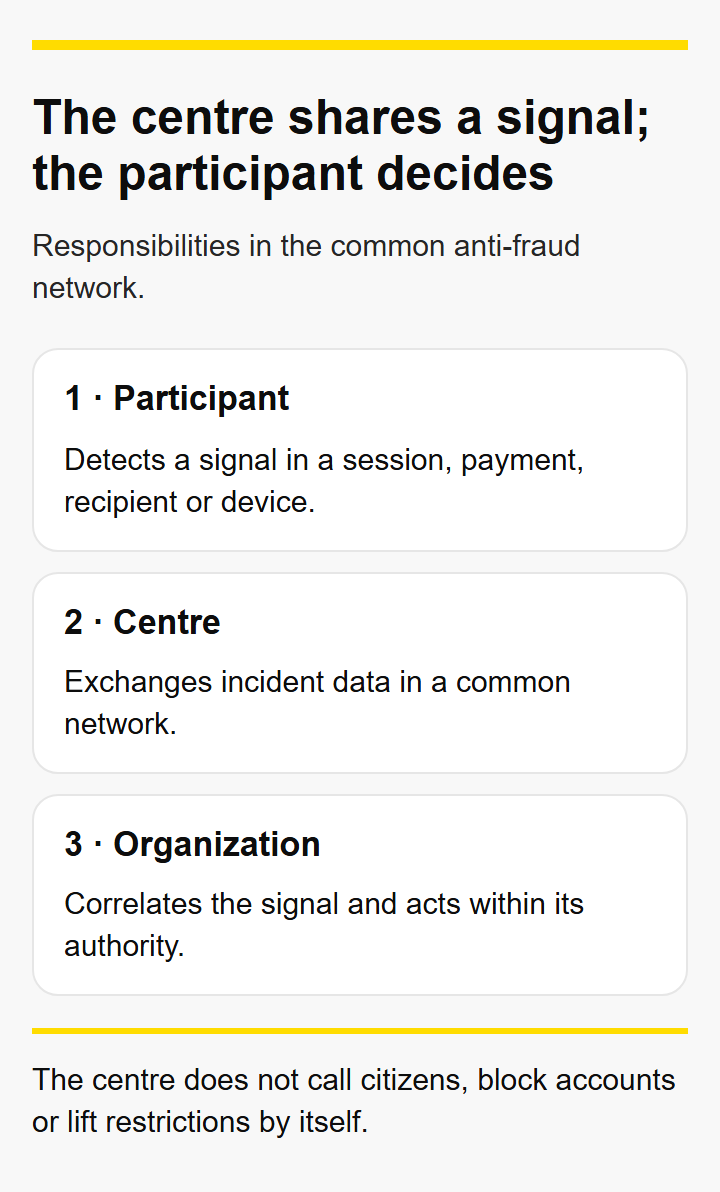
An institution finds signs of fraud in a session or transaction.
It creates an incident with the required attributes and sends it to the shared system.
Other participants receive a relevant signal and compare it with their own data.
An authorized organization acts within its powers: delays a transaction, restricts a channel, escalates the case, or requests a check.
The decision, grounds, time, and later status are kept for investigation and possible restitution.
Who participates and what each sees
According to the National Bank, more than 200 participants were connected by June 2025: banks, payment and microfinance organizations, telecom operators, law-enforcement bodies, and other government agencies. Credit bureaus were added in 2026. They must promptly report cases in which someone applies for a consumer loan or microloan to two or more financial institutions within an hour.
Participation does not give everyone equal access to all information. An organization’s role determines what it sends, on what basis it receives a response, and which actions it may take. Data minimization matters even in fraud prevention: a “shared database” is not permission to copy an entire customer profile into every incident.
The National Bank also warns that Anti-Fraud Centre staff do not call members of the public or collect their data. The platform deals with organizations. A call “from the Anti-Fraud Centre” asking for a code is itself a warning sign of an attack.
Where the centre’s responsibility ends
The National Bank identifies three limits:
the centre does not decide to add or remove people from databases;
it does not block bank accounts or cards;
incidents are created on the basis of decisions by financial institutions and law-enforcement bodies.
A participant therefore needs more than a saved API response. In a dispute, its own grounds matter: which signal fired, what other data were checked, who approved the action, and what was needed to lift the restriction. If a transaction was declined only because “the centre said so,” the decision trail is incomplete.
A model: signal, decision, action, restoration
Layer | System question | Minimum evidence |
|---|---|---|
Signal | What caused suspicion? | Indicator type, source, time, and incident ID |
Decision | Why was the signal considered sufficient? | Rule version, further checks, responsible role |
Action | What was restricted, and by whom? | Transaction, channel, or account; legal ground; time |
Restoration | How can a false positive be corrected? | Investigation status, responsible body or organization, and ground for lifting the restriction |
This is a suggested operating model, not a quotation from Rules No. 54. It addresses a dangerous gap: rapid sharing without a controlled route for lifting restrictions may reduce losses while increasing harm from false positives.
Connecting shared signals to session-level fraud controls
The shared system sees links across institutions; a local system sees behavior inside the app. The two complement each other. The National Bank reported a pilot that analyzes user actions within a session. Such analysis could consider an abrupt device change, unusual navigation, remote control, an atypical recipient, or actions dictated by a scammer.
Biometrics can help at certain points, but should not automatically trigger for every external signal. Another liveness and Face Match check may make sense when risk suggests account takeover or impersonation. If the signs point to social engineering and the customer is personally confirming a transfer to a fraudster, a successful face match does not make the transaction safe.
Biometric.Vision’s verification modules can add liveness, repeat face comparison, and a managed decision route. They neither replace a connection to the national centre nor make the organization’s legal blocking decision.
Participant checklist
Before production integration, check whether:
someone owns the process for incoming and outgoing incidents;
external ID, customer, device, recipient, and local session can be matched unambiguously;
response times are defined for different signal types;
automatic restrictions are distinguished from manual escalation;
unnecessary personal data are excluded;
reasons for status changes are recorded;
customers and operators have a clear route for false positives;
an outage of the shared system is tested without disabling local fraud controls.
The central architecture error is treating the Anti-Fraud Centre as a ready-made risk score. It is a coordination network. It makes local signals useful to other participants and returns outside context to an organization. The final decision still depends on internal rules, the team’s speed, and a complete audit trail.
Sources
Rules for operating the National Bank’s Anti-Fraud Centre, Resolution No. 54.
National Bank: launch of the Anti-Fraud Centre, 5 August 2024.
National Bank: limits of the centre’s powers, 27 December 2024.
National Bank: results as of 1 January 2026, 4 February 2026.
Originally published in Russian. Adapted for English readers.
This article is for information only and does not replace advice from a qualified lawyer.
Ready to strengthen your customer checks?
500 free checks a month for a year · no card · no contract · no sales call.