Kazakhstan’s Digital Code: what changed for digital identification
What articles 44–48 change in identification, authentication, biometrics, and proof of a customer’s actions.


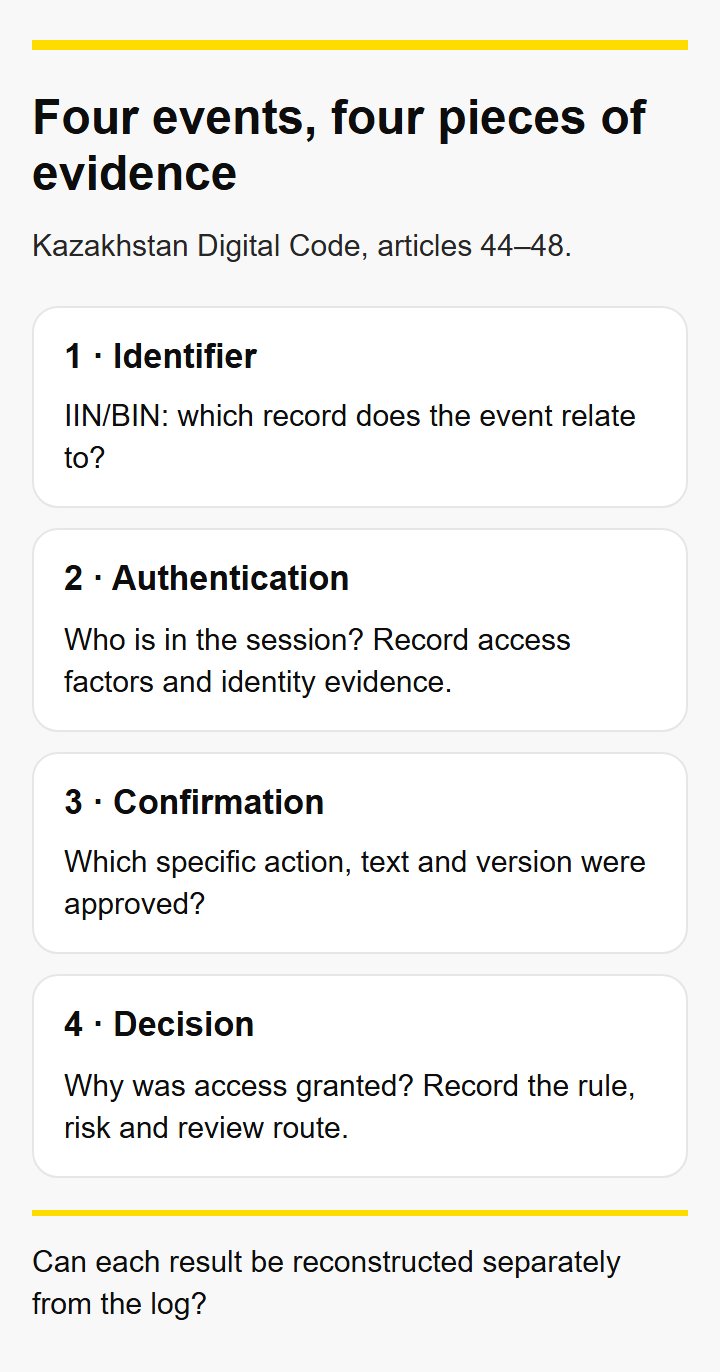
A customer enters their individual identification number (IIN), receives an SMS code, and confirms a transaction with a selfie. Calling this entire journey “identification” makes it hard to say what each event proved in a dispute. Kazakhstan’s Digital Code separates the events in law: an identifier links a record to a subject, authentication confirms identity at access, and digital confirmation records an expression of intent after authentication. Biometrics is one authentication method, not a universal substitute for a signature.
The Digital Code was adopted on 9 January 2026. Article 106 brings it into force six months after first official publication. By September 2026, adding a term to a policy was therefore insufficient: businesses needed to separate the events in system architecture and evidence logs.
At a glance
An IIN or business identification number (BIN) identifies a record; knowing the number does not authenticate its user.
Multifactor digital authentication can have legal effects when the applicable requirements are met.
An SMS code, push approval, or biometric confirmation can express an action after authentication without becoming a digital signature.
Mandatory biometrics is allowed only where a law provides for it.
Sector regulators specify the biometric-authentication procedure for financial and payment organizations.
The Code separated four outcomes in one user journey
Article 45 calls the IIN the unique identifier of an individual and the BIN that of a legal entity. An identifier answers “which record does this event concern?” It does not prove who entered the number or whether that person may act for the subject.
Article 46 defines digital authentication as confirmation of an individual’s identity or a legal entity’s capacity when accessing a digital service. This gives the system a different result: grounds to trust the current session. Paragraph 4 connects multifactor authentication to the creation, change, or termination of legal relationships and proof of legally significant actions.
Article 47 introduces digital confirmation: an expression of intent after authentication. A code, password, one-time identifier, push notice, or biometric confirmation can be used where a law or agreement provides for it. Paragraph 4, however, expressly distinguishes this confirmation from a digital signature. It does not protect the authenticity and integrity of a digital record’s contents in the same way.
Article 48 governs biometric authentication. Biometric data are personal data; mandatory processing needs a statutory basis. A national biometric-authentication system is provided for government processes, while the ARDFM and National Bank define the procedure for financial and payment organizations.
Why Face Match alone is insufficient
Comparing a selfie with a document portrait answers a narrow technical question: are the images similar under a specified algorithm and threshold? It does not automatically establish that the document is valid, the selfie shows a live person, the user agreed to this transaction, or the method is permitted for the service.
Five independent checks make up a practical model:
Check | Fact it establishes | What remains outside its scope |
|---|---|---|
Identity source | Details came from a permissible document or register | Who controls the current session |
Document | Fields, validity, and available forgery signs passed checks | Whether the presenter is live |
Liveness | A live person rather than a basic spoof is before the camera | Whether the face matches the reference |
Face Match | The current face matches a reference portrait | Intent to take an action |
Confirmation | The user confirmed a specific action after authentication | Equivalence to a digital signature without the required grounds |
Biometric.Vision Liveness looks for live presence, not legal identity. An orchestrator can connect document, liveness, and face-comparison results in one process, but the organization sets the legal ground, wording of the action, and final decision rule.
Multifactor authentication must be evidenced
Two sequential screens do not necessarily mean two independent factors. If SMS and account recovery rely on the same compromised phone, the second step may not offset compromise of the first. A gallery-uploaded selfie without liveness controls adds an image, not a strong proof of presence.
For each factor, record three properties:
Independence: compromising one factor should not automatically expose the other.
Connection to the action: the log should show whether it confirmed a login, contract, transfer, or change of details.
Freshness: the evidence should belong to the right session and time window, rather than be reused without controls.
These are editorial and engineering recommendations, not a verbatim rule from article 46. They make a claim of “multifactor authentication” demonstrable from system records.
An automated decision needs a review route
Article 43 gives a subject the right to know about fully automated algorithmic decisions, receive an explanation of key factors, and request review involving a specialist where a decision has legal effects or affects rights and legitimate interests, in the cases and manner prescribed by law.
For eKYC, this changes refusal design. face_mismatch or liveness_failed should not silently become a final “customer refused.” Keep the reason, rule version, input evidence, and a permissible route for another attempt or human review. Keeping a full selfie indefinitely “just in case” is not acceptable either: the retention period and data scope must follow the legal ground and processing purpose.
What to change in systems and documents
Start with an event map rather than renamed screens:
separate under the Code a user identifier from evidence of the identity source;
record document, liveness, and Face Match results separately;
bind confirmation to the text and version of the specific action;
keep the time, session, SDK version, threshold, and reason for an automated decision;
provide another route when a user cannot complete digital identification: article 41 permits another lawful method if digital identification is unavailable;
check sector-specific requirements before making biometrics mandatory.
Biometric.Vision does not determine the legal effect of a user’s action or replace the national biometric-authentication system. It provides technical results and joins them in a managed process. Orchestrator can support that process while the rules retain separate statuses for data source, liveness, similarity, confirmation, and human decision.
The final test is simple: if a log cannot independently answer “whose record?”, “who controlled the session?”, “what did the user confirm?”, and “why was this decision made?”, new terminology has not yet been implemented. The Digital Code makes these questions legally distinct; the architecture needs to make the answers reproducible.
Sources
Digital Code of Kazakhstan No. 255-VIII, articles 41, 43–49 and 106.
Originally published in Russian. Adapted for English readers.
This article is for information only and does not replace advice from a qualified lawyer.
Ready to strengthen your customer checks?
500 free checks a month for a year · no card · no contract · no sales call.