Fayda Digital ID in Ethiopia: eKYC and Biometric Authentication
Learn what Ethiopia's Fayda Digital ID proves, how online and offline authentication work, and what banks and service providers must still control.


Fayda can answer a difficult identity question: does this resident correspond to a unique record in Ethiopia's foundational ID system? It cannot answer a different question for a bank: should this person receive this account, limit or transaction now? If you merge the two decisions, a strong national identity signal ends up as an overextended KYC shortcut.
Ethiopia's Digital Identification Proclamation No. 1284/2023 established Fayda as foundational legal identity. The system issues a unique number to eligible residents and uses demographic and biometric data to support uniqueness and authentication. A service provider should consume only the authorised assertion it needs for a given purpose, then apply its own eligibility, AML, fraud and lifecycle controls.
In brief
Fayda is foundational identity infrastructure for residents, not a customer-risk score.
The National ID Program describes online eKYC using a Fayda number or alias, a customer OTP for consent and available facial or fingerprint authentication routes.
Offline verification can use the QR code on a Fayda credential, but a decoded credential still needs freshness, integrity and holder-binding rules.
A business cannot assume open access: confirm its relying-party agreement, permitted service, attributes and production environment.
Ethiopia's draft Digital Payments Strategy says no directive yet mandates Fayda as the unique KYC identifier for every account and wallet; the mandate is a target for 2030.
Banks must keep identity proof separate from sanctions screening, customer risk, product approval and ongoing monitoring.
What Fayda establishes
The Fayda strategy describes a unique identification number issued to residents who complete National ID Program procedures. It collects demographic data and biometrics for the purpose of establishing a unique identity. The published biometric set includes fingerprints, iris scans and a face photograph; the program also documents exceptions when a modality cannot be captured.
The Fayda benefits page cites article 16(1) of the Digital Identification Proclamation and states that Fayda ID is legal and sufficient proof of identity. It lists financial uses such as opening bank accounts and accessing microfinance services.
“Sufficient proof of identity” should not be read as “sufficient proof for every business decision.” Foundational identity establishes a person within the national system. A service provider may still need to establish authority, beneficial ownership, expected activity, eligibility, sanctions or PEP exposure, source of funds, device risk or other product-specific facts.
Think of it as two records:
Record | Core question | Owner of the final decision |
|---|---|---|
Fayda authentication | Is this claimant linked to a valid foundational identity under the used method? | National ID service returns the defined assertion |
Service-provider decision | May this authenticated person perform the requested action under current risk and policy? | bank, telecom or other authorised provider |
The second record should reference the first without pretending they are the same decision.
Online eKYC is a consented assertion flow
The National ID Program's authentication page describes an eKYC service in which a provider requests a customer's Fayda Alias Number or Fayda Identification Number through the secure portal. The customer receives an OTP that provides consent for the service, after which the provider can view a printable credential. The same page describes online authentication capabilities involving OTP, selfie facial recognition and fingerprint scans.
An implementation should preserve the following evidence separately:
the provider and service that requested the assertion;
the customer identifier used, with unnecessary exposure minimised;
the purpose and attributes requested;
the consent challenge, channel, time and result;
the authentication method and response status;
the returned attributes, source timestamp and transaction identifier;
the provider policy that used the assertion.
OTP consent should not be described as biometric proof, and a biometric response should not be described as acceptance of product terms. If the customer controls the OTP channel but the face check is inconclusive, record two separate outcomes. Do not average them into one score.
Offline verification needs a different threat model
Fayda also describes offline authentication through the QR code, called FaydaEncode, on a credential. Offline presentation can improve access where connectivity is weak and can reduce unnecessary online lookups.
Its risks differ from online eKYC. The verifier needs rules for checking integrity, issuer signature or other authenticity mechanism supported by the official specification, credential freshness, revocation or update status, and the link between the credential and the presenter. A screenshot of a QR code is not automatically proof of live possession or current validity.
Do not invent verification fields from the visual credential. Build against the current official manual and approved integration. Decide what happens when the device clock is wrong, the verification key is stale, the QR is unreadable or the holder has updated identity data since issuance.
The trust boundary in one diagram
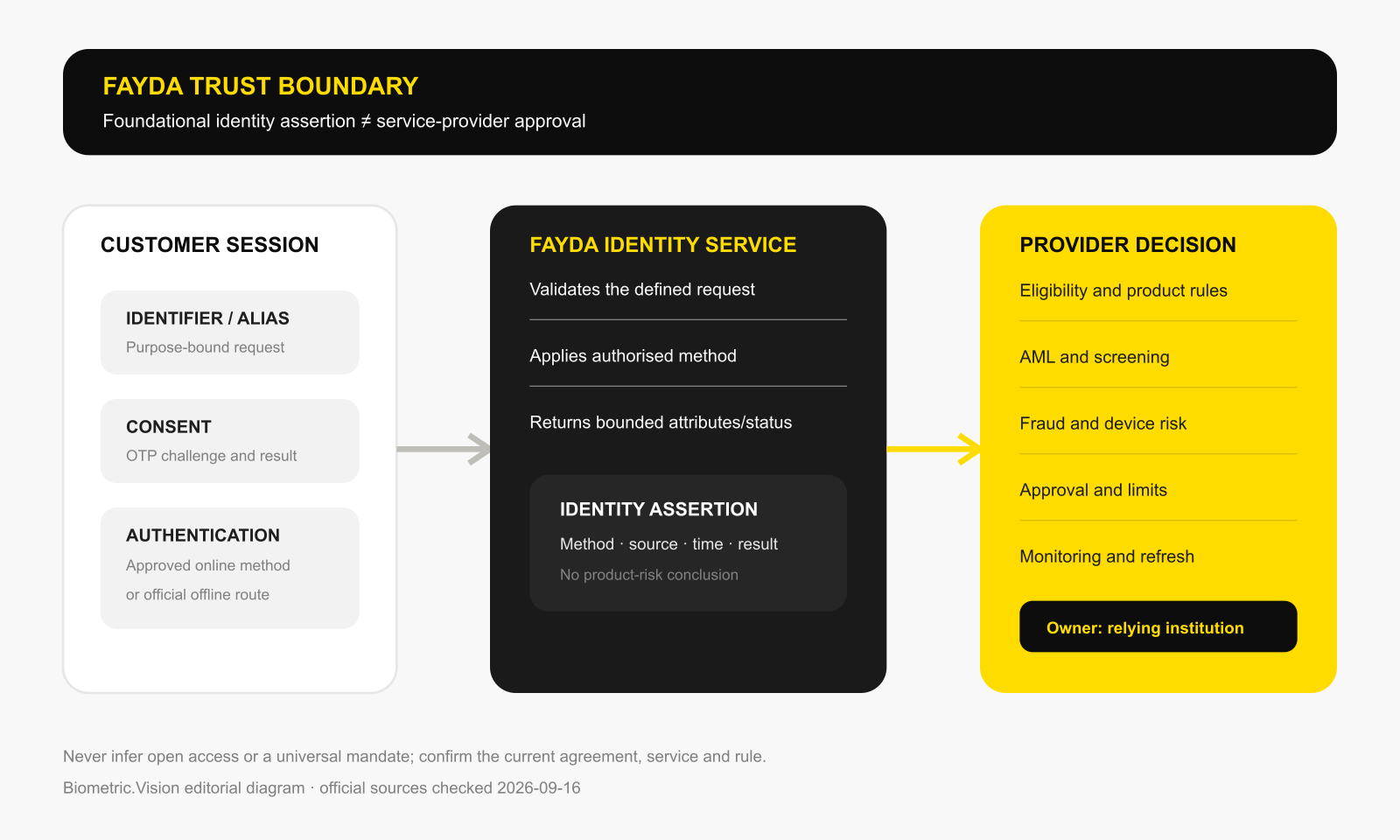
The provider should not copy the entire identity record into every downstream system. Map each use case to the minimum assertion required. Account opening may need a different attribute set from account recovery or transaction authentication. Keep the purpose, legal authority or consent route and retention policy explicit.
The Fayda principles page emphasises privacy, minimal data collection, purpose-driven use and consent for third-party access. Service providers should translate these principles into API scopes, role-based access, masked logs, retention schedules and customer-access records.
Do not claim universal or mandatory access
A public description of an eKYC service does not make it an open API. A business should confirm:
eligibility to become a relying party;
the executed agreement and permitted use cases;
approved environments, credentials and certification steps;
available authentication methods and attribute scopes;
production service levels, error meanings and support route;
security, incident, audit and data-deletion obligations.
The Fayda Connect page directs users to official provider-linking pages and publishes a banks harmonisation guide route. That points to an ecosystem of approved providers. An intermediary does not get unrestricted access through it.
Current law and future policy also differ. The National Bank of Ethiopia's published National Digital Payments Strategy 2026–2030 is marked as a draft. Its baseline says no directive has yet mandated Fayda as the unique KYC identifier for all accounts and wallets; issuing such a directive and reaching full linkage are targets for 2030. A roadmap target must not be reported as an already effective universal mandate.
Biometrics at enrolment and authentication do different jobs
Fayda uses biometrics during enrolment to support uniqueness and later offers biometric authentication mechanisms. A service provider may also use a local face capture. These operations require separate definitions.
Enrolment deduplication asks whether a new applicant appears already represented in the foundational system.
Fayda authentication asks whether the current claimant matches the identity under an approved method.
Local face match compares a capture with a reference available to the provider.
Liveness or capture integrity tests for covered presentation or injection attacks.
More biometric checks do not automatically mean stronger assurance. If two checks use the same untrusted image, their errors are correlated. Document the trusted reference, threshold, capture channel, covered attack classes, exception route and decision owner.
Biometric.Vision Face Match can compare a current face with an available reference. This does not imply a connection to Fayda or permission to retrieve Fayda data. Any such integration must be confirmed through the official relying-party route.
Build the bank or business decision around the assertion
The NBE and National ID initiative describes Fayda as a basis for financial-sector onboarding and eKYC. The identity assertion anchors the customer, and the institution adds its own control layers on top.
For onboarding, link the Fayda result to:
the customer role and requested product;
required additional data and documents;
sanctions, PEP and adverse-information screening under policy;
expected use, geography and transaction profile;
device and channel-fraud signals;
approval authority, limits and exception outcome;
monitoring, data refresh and re-authentication triggers.
Biometric.Vision Orchestrator can coordinate external identity assertions with document, biometric and screening steps. Its use depends on those official approvals, and it does not make Biometric.Vision an approved Fayda relying party.
Failure modes should stay visible
Avoid converting every non-success into “not found.” Use distinct states for invalid request, no matching identity, consent denied, OTP expired, authentication mismatch, insufficient quality, service unavailable and response expired. Each state permits a different next action.
Fallback must preserve assurance. If online authentication is unavailable, accepting an unverified credential photo may create a silent downgrade. Define whether the customer waits, uses an approved offline mechanism, visits an authorised channel or enters controlled manual review. Log the selected route and reason.
Account recovery is especially sensitive. A provider should not replace the phone or reset credentials using weaker evidence than the original binding without a documented risk decision. Treat changes to contact channels and identity attributes as events that may require re-authentication and monitoring.
Questions for an integration review
Which official Fayda service and relying-party agreement covers this use case?
What exact assertion is returned, and how long is it considered current?
How are purpose, consent and authentication recorded separately?
Which attributes are needed, and which can remain undisclosed?
How is the presenter bound in online and offline journeys?
Can outage, retry or manual fallback weaken a mandatory control?
Which customer decision remains with the bank or service provider?
Can an auditor reproduce the identity assertion and the downstream decision?
Fayda gives Ethiopia's digital economy a strong identity anchor. Use it for what it proves: request an authorised, minimal assertion, record exactly what it established, and keep product risk, AML, fraud and ongoing monitoring inside your own accountable decision process.
Ready to strengthen your customer checks?
500 checks free every month · no card · no contract · no sales call.