How to Integrate Biometric eKYC Identification into Logistics
Today, logistics is a complex ecosystem where every transaction requires identity verification of drivers, couriers, warehouse operators, and parcel…

In logistics, every transaction involves verifying the identity of drivers, couriers, warehouse operators, or parcel recipients. eKYC is built for exactly that check.
What Is eKYC and Why It Matters for Logistics
eKYC (Electronic Know Your Customer) verifies a person’s identity digitally, with no visit to a physical office. It replaces paper documents and handwritten signatures with passport OCR scanning and biometric confirmation through facial recognition.
Logistics feels the identity verification problem more than most industries:
- Slow driver onboarding: manual checks drag out verification and onboarding
- Forged documents: drivers work under someone else’s credentials
- Legal exposure: carriers cannot confirm who was actually driving a vehicle
- Last-mile delivery: a courier cannot verify the recipient’s identity when handing over a high-value shipment
According to IDScan.net, identity fraud losses at logistics companies have grown by more than 4% over the past two years alone and now equal 2.15% of total turnover. For a major player, that means millions of dollars a year.
eKYC Solution Architecture in Logistics
Before you implement anything, map the building blocks. A ready-made ecosystem that covers a logistics company’s full operational cycle has three core components:
1. Document Verification
The user photographs their passport or driver’s license. An OCR engine extracts the data, while an algorithm verifies the authenticity of security features, the integrity of the MRZ (Machine Readable Zone), and the consistency of data across different zones of the document.
2. Liveness Detection
This step catches attempts to fool the system with a photograph. Liveness detection works in two modes: passive, which analyzes a static frame for signs of spoofing, and active, which asks the user to blink or turn their head in real time.
3. Face Matching
The system extracts a biometric facial template from the document and compares it with the user’s live face. The similarity threshold is usually set between 0.85 and 0.95, depending on the security level you need.
Practical Integration: A Step-by-Step Plan
Step 1. Choose a Provider or Build In-House
The market has several mature providers:
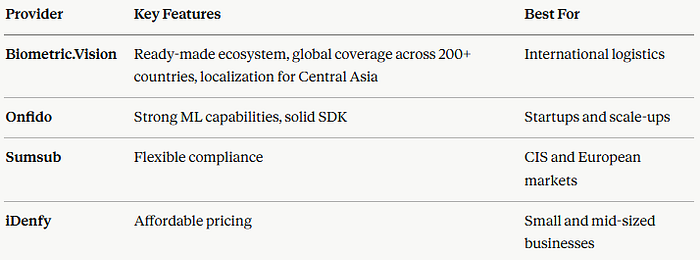
Biometric.Vision offers a ready-made ecosystem with global coverage across 200+ countries and strong localization for Central Asia and CIS markets, which suits international logistics operations. Sumsub is well established in CIS and European markets and has flexible compliance tooling. Onfido has strong machine learning capabilities and a developer-friendly SDK, and fast-growing companies use it widely. iDenfy costs less and fits small and mid-sized logistics businesses that want to start with eKYC without a heavy upfront investment. All four offer API-based integration, so you can embed them in existing logistics platforms, driver apps, or warehouse management systems with relatively little engineering work.
An in-house build makes sense only when verification volumes reach 100,000+ per month and you have a specialized development team.
Step 2. Use Cases in Logistics
Before integrating anything, ask where exactly identity verification breaks down in your process. You don’t need biometrics everywhere at once. Start with two or three touchpoints where the risk or the operational pain is highest.
In logistics, these touchpoints usually include:
Accelerated Remote Onboarding of Drivers and Couriers
Onboarding a new driver used to mean a trip to the office with original documents, a wait while HR reviewed everything by hand, and paperwork to sign. That took at least 2–3 days. With eKYC, the driver finishes in under 5 minutes on a smartphone.
The driver downloads the app, photographs their driver’s license and passport, and completes a liveness check, which confirms that a real person is in front of the camera and rules out a photo, video, or deepfake. The system verifies document data automatically and compares the face on the document with the face on camera. If everything matches, the profile goes live with no manager involved.
For companies with high staff turnover, this changes the economics of hiring. You can onboard people at any time of day, from any city, without a dedicated team of onboarding managers.
Warehouse Access Control
A warehouse holds high-value goods, and dozens of people come and go every day. Access cards get lost, lent to colleagues, and sometimes misused on purpose. Biometric access control removes these risks.
An employee walks up to the turnstile, the camera reads their face, and in a fraction of a second the system finds a match in the full personnel database. Nobody needs a card or a PIN code. If the person is in the system and has rights to that zone, the turnstile opens. If not, it stays locked and security gets an alert.
The system can also log who was on the premises and when, which helps with time and attendance tracking as well as security.
Step 3. Compliance with Biometric Data Requirements
Biometric data is the most sensitive part of the project. A biometric solution provider must meet several criteria:
International Standards Compliance
Any platform that handles biometric data must meet international standards as a baseline. GDPR is the international benchmark and the de facto industry standard. ISO/IEC 30107–3 certifies that liveness detection resists spoofing attacks with photos and deepfakes. ISO/IEC 27001 confirms that data protection processes are implemented in practice as well as written down.
Local Regulatory Compliance
International standards are not enough on their own. Local legislation changes quickly, and a reliable provider keeps up with it. Requirements differ widely between jurisdictions: some countries prohibit storing biometric data on foreign servers, others mandate data localization, and some require specific accreditation.
Common Implementation Mistakes
1. Ignoring Presentation Attack Detection (PAD) A system that cannot tell a live face from a photograph, deepfake, or mask does not protect you. Check that your provider holds ISO/IEC 30107–3 certification.
2. Setting the Accuracy Threshold Too High A face match threshold that’s too high will reject genuine users (false negatives). Too low, and it will let fraudsters through (false positives). Start at 0.87–0.90 and calibrate based on real-world data.
3. Insufficient Adaptation to Challenging Conditions Biometrics can struggle with poor connectivity and low-end devices. Choose providers who have tested their solution in real field conditions: weak internet, poor lighting, budget-grade cameras. If the demo only works on the latest iPhone, look for another provider.
4. Overlooking UX When you evaluate a provider, check its analytics as well as algorithmic accuracy. A complicated verification flow drives high drop-off. A good platform shows the exact step where users give up: a failed document scan, a struggle with the liveness check, a frozen upload. Without that data, you are improving the product blind.
Conclusion
Integrating eKYC into logistics moves a company from paper-based trust to trust built on verified data. A well-implemented system cuts fraud, speeds up onboarding, improves UX, and gives the company legal protection.
Start small. Pick one use case, such as courier onboarding, run a pilot with a cloud-based provider, measure the results, and scale only after that.
Biometrics will not fix every process on its own. A team that picks its touchpoints carefully can still change how it onboards drivers, controls warehouse access, and hands over shipments.
Ready to strengthen your customer checks?
500 free checks a month for a year · no card · no contract · no sales call.