MyID in Uzbekistan: how business identity checks work
What data and results MyID provides, where its responsibility ends, and which decisions, consents, and evidence remain with a business.


A successful MyID response confirms that a person completed the prescribed biometric procedure and their details were matched with government sources. It does not answer three other questions for a business: may this product be opened, does the customer fit the risk policy, and what action did the customer then confirm? Keeping only success would conflate those decisions in a dispute.
MyID is UZINFOCOM’s biometric-identification system. According to its official description, it uses facial recognition and liveness checks, obtains biographical and biometric details from government information systems, and is used by banks, payment services, insurers, telecoms, and other sectors. It supplies a trusted identity-check layer, not a complete KYC decision.
At a glance
MyID connects a presenter to government-source data through a biometric procedure.
Consent to data sharing, a service response, and the company’s decision are separate events.
Integration may use App, Mobile SDK, Web SDK, Server SDK, or Cloud according to the officially available use case.
Successful identification does not replace AML checks, product eligibility, or fraud controls.
Audit evidence should include the session ID, data shared, result, and final decision rule.
What MyID can establish
The official description presents MyID as a way to identify and authenticate individuals through unique facial biometric parameters. Core data come from the information systems of the Personalization Centre and the Ministry of Internal Affairs. Its privacy policy lists, among other details, a digital facial portrait, personal identification number (PINFL), passport or ID details and expiry, name, nationality, and registration details.
A company must not treat that list as permission to request everything. The MyID policy says data are shared with an external information resource with the user’s consent, displaying the resource’s name and owner and the list of data shared. An integration should request the minimum needed for the service and bind consent to that list.
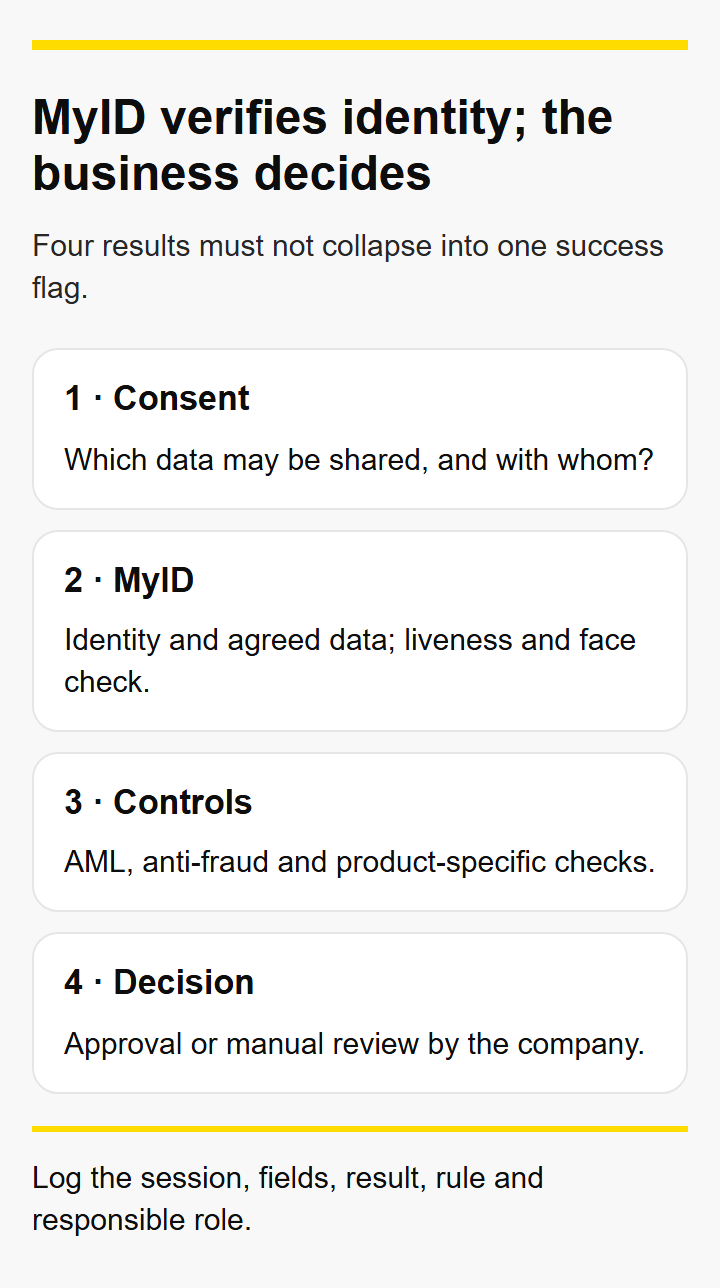
Five events instead of one status
1. The company creates an identification session
Bind it to the application, channel, and a limited validity period. This helps prevent an old result from being reused for another transaction.
2. The user sees who receives which data
Consent is not a decorative checkbox. A useful log keeps the wording version, recipient, data fields, time, and method of consent. This is a suggested evidence model; applicable law and the contractual structure determine the exact document.
3. MyID checks the presenter and returns a result
The service uses biometric comparison and liveness. The business needs a machine-verifiable response tied to the same session, not a screenshot of the user’s screen. Distinguish technical errors, user withdrawal, failed biometrics, and successful verification.
4. The company performs its own checks
A bank or payment service must still do customer due diligence, sanctions and PEP screening, fraud assessment, product eligibility, and limits. MyID establishes identity but neither determines source of funds nor resolves a list hit.
5. A rule makes and explains the decision
The final status should link its inputs: myid_verified, screening_reviewed, and risk_approved. A single KYC passed conceals what was checked and which component caused a refusal.
What remains the business’s responsibility
Question | MyID | Company |
|---|---|---|
Who presents the face? | Performs the prescribed biometric check | Chooses a permitted scenario and handles exceptions |
Which government data are linked to the person? | Returns details from the stated sources | Requests only necessary fields and checks their suitability |
May the product be opened? | Does not decide | Checks law, risk, age, limits, and product rules |
Is there sanctions or PEP risk? | Does not make the final AML decision | Screens and resolves matches |
Why was the customer accepted or refused? | Supplies its step result | Keeps the complete final reasoning |
This division prevents opposite mistakes: treating MyID as a mere camera and recollecting confirmed data, or treating a positive response as permission for any service.
When additional biometrics may be useful
If a company captures a document itself or has a separate risk scenario, it may need Document Verification, Face Match, or another liveness check. Duplication without a reason adds friction and more biometric processing.
The test is whether there is a new question. If MyID has established identity, another Face Match may make sense when a different image or new high-risk session must be linked to the reference. If the question is unchanged, first consider whether the existing result is sufficiently current.
Biometric.Vision Orchestrator can join external identity confirmation, document checks, Face Match, liveness, and AML signals in one process. Biometric.Vision is not MyID’s operator and does not claim a ready-made connection to Uzbekistan’s government system on its product page; MyID integration follows MyID’s official terms.
A minimum integration log
For each attempt, keep:
internal and external session IDs;
creation, completion, and expiry times;
consent version and shared data fields;
channel type and integration version;
MyID’s result and error code, without replacing all errors with
fail;later AML and fraud-check results;
rule version, final decision, and responsible role;
retry or human-review route.
Source images need not necessarily be retained as long as the decision outcome. Set periods for biometrics, logs, and customer files separately according to purpose and legal ground.
MyID shortens the distance between government data and a digital service. A sound integration uses that advantage without asking one response to decide customer risk, product eligibility, and proof of a particular expression of intent.
Sources
Originally published in Russian. Adapted for English readers.
This article is for information only and does not replace advice from a qualified lawyer.
Ready to strengthen your customer checks?
500 free checks a month for a year · no card · no contract · no sales call.