Kazakhstan’s AML/CFT law: requirements and business duties
A guide to Law No. 191-IV: who is subject to financial monitoring, when to perform due diligence, and what evidence to keep.

The most costly mistake when reading Kazakhstan’s AML/CFT law is to begin with a list of suspicious transactions. By that point, a system should already know whether the organization is subject to financial monitoring, who its customer and beneficial owner are, what risk has been assigned to the relationship, and what events require a case file to be updated. Without that foundation, monitoring produces many alerts but the organization cannot explain why one was dismissed and another sent to the authority.
The principal act is Kazakhstan’s Law No. 191-IV on countering money laundering, terrorist financing, and financing the proliferation of weapons of mass destruction. In 2026, it cannot be read as a static checklist: specific procedures depend on the category of regulated entity, subordinate requirements for internal-control rules, and the current text of the law.
At a glance
First determine whether the organization belongs to a category subject to financial monitoring under article 3.
Due diligence means more than copying an identity card: it includes identification, verification, beneficial-owner checks, the relationship’s purpose, and ongoing monitoring.
Checks generally take place before a business relationship begins, but the law provides special cases and exceptions.
Sanctions and PEP screening are controls, not substitutes for a risk profile and transaction analysis.
An audit needs to reconstruct the data, rules, and responsible person behind the result, as well as the result itself.
First question: is the organization subject to financial monitoring?
Article 3 lists entities subject to financial monitoring. They include banks and organizations performing certain banking operations, insurers and securities-market participants, microfinance and payment organizations, specified professionals, notaries and lawyers in stated circumstances, accounting and legal-service organizations for certain operations, digital-asset operators, and other categories.
The current law adds new digital-finance participants. Resemblance to “fintech” therefore settles nothing by itself. Applicability depends on actual activity, the licence, and the precise subparagraph of article 3.
An organization outside the list may still need KYC and fraud controls under sectoral law, contract, risk management, or personal-data protection. But it must not present voluntary controls as fulfilment of every duty imposed on entities subject to financial monitoring.
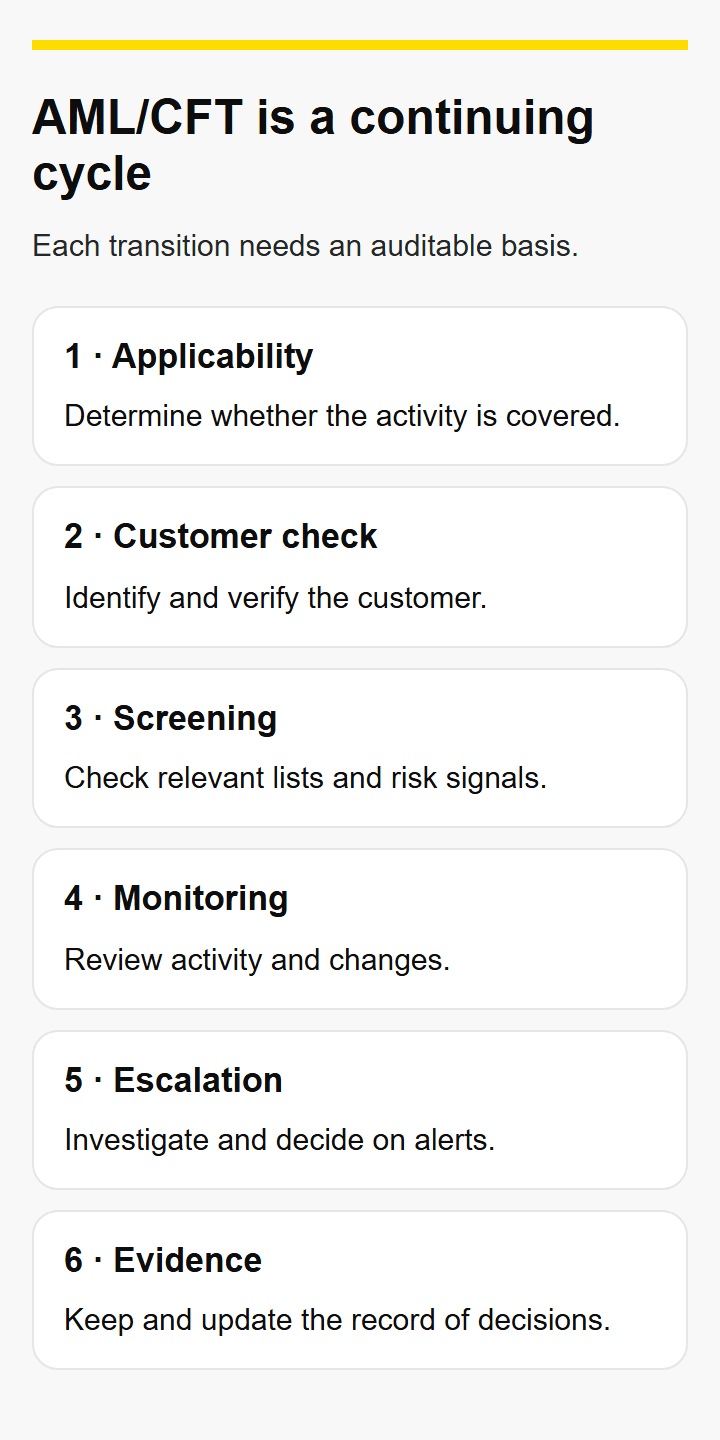
The law creates a control cycle, not a list
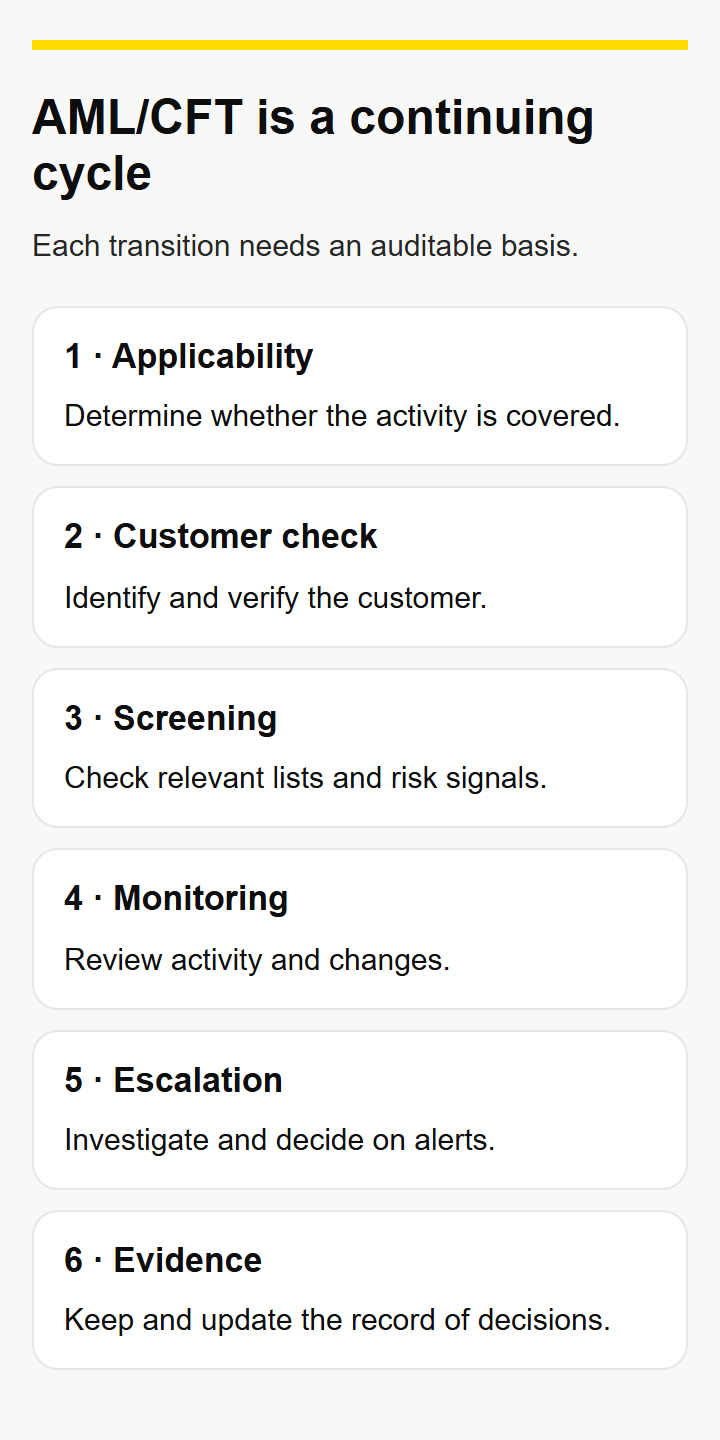
1. Classify the relationship and risk
Before choosing a procedure, establish the customer type, product, channel, geography, nature of the transaction, and higher-risk factors. A document may be enough to collect basic details but insufficient for a complex ownership structure or a high-risk remote scenario.
2. Perform due diligence
Article 5 requires measures concerning the customer, representative, and beneficial owner. These include recording necessary details, checking accuracy, establishing the intended purpose and nature of the relationship, and continually reviewing transactions and the currency of information.
As a general rule, key measures precede the relationship. Check special regimes against the current article and the rules for the relevant entity type; do not move an exception from one sector into another.
3. Carry out targeted checks
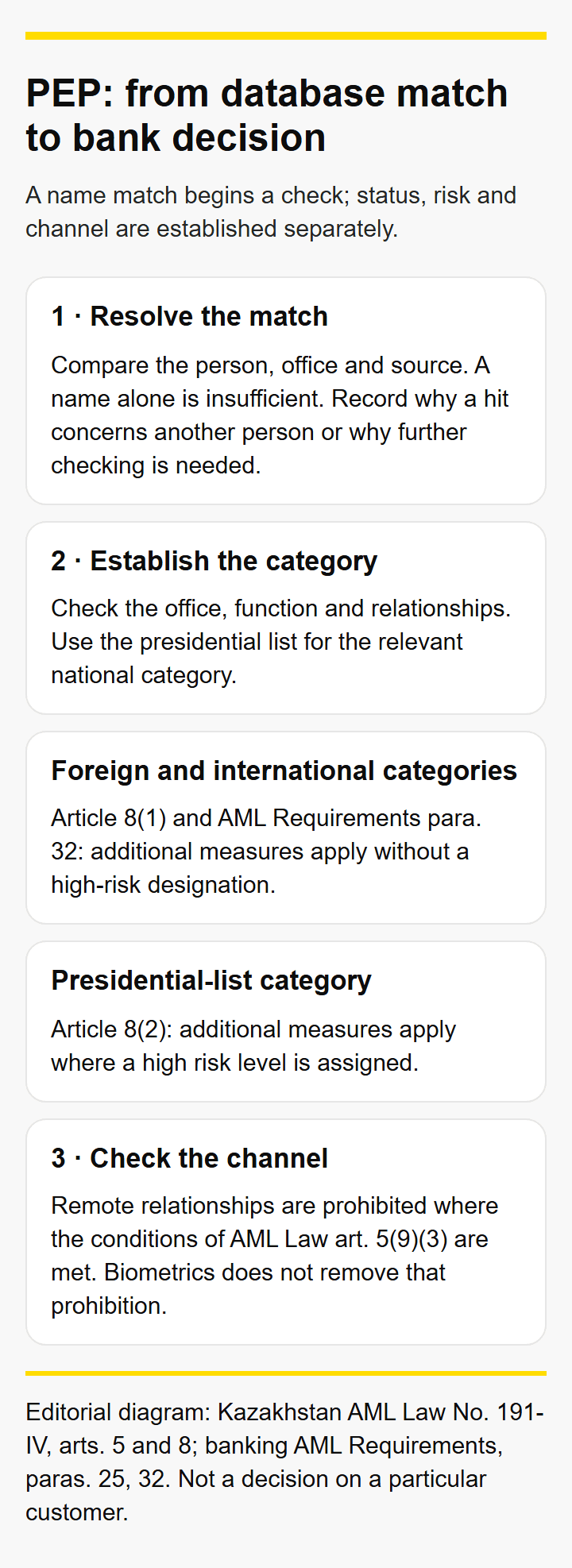
These include lists associated with terrorist and proliferation financing, sanctions and PEP screening, and resolution of matches. A name match is a candidate, not a decision. Date of birth, nationality, identifier, list source, and a documented conclusion are needed.
Biometric.Vision AML Screening checks individuals and companies against its stated sanctions, PEP, and other lists, supports repeat monitoring, and logs results. It helps automate search and review but does not decide whether the law applies or replace a responsible employee’s decision.
4. Monitor transactions and customer changes
Control continues after onboarding. Changes of owners, directors, product, geography, transaction profile, or lists may matter. “KYC passed” must not become a permanent status. A next-review date and event-based triggers are both needed.
5. Escalate and report
If a transaction meets defined criteria or appears suspicious in its circumstances, the system routes the case to an authorized role. Whether information must be reported follows the law and the regulated entity’s rules. A technical risk score is not a report to the Financial Monitoring Agency.
6. Keep evidence and update internal-control rules
Article 11 links duties to internal-control rules. The process should be documented, with responsible people, training, risk assessment, monitoring, and retention defined. An elegant document does not close a gap if the real system works differently.
Three layers that are often confused
Layer | What it establishes | Common error |
|---|---|---|
Law No. 191-IV | Basic entities, duties, and powers | Looking there for every technical API field |
Sectoral requirements and internal-control rules | Procedure for a particular regulated entity | Copying bank rules into a nonfinancial sector |
Information system | Execution, routing, and evidence | Treating a vendor setting as a legal decision |
The law says what is required, an internal rule says who decides and when, and the system shows how the event was performed and evidenced. A sound process does not substitute one layer for another.
What evidence of a check should look like
One AML: pass line is insufficient for a decision. A reproducible case file contains:
the customer identifier and version of the details collected;
the source and time of identity or company-registration verification;
the established beneficial owner and chain of ownership or control;
assigned risk factors and the methodology version;
the lists used and their update dates;
potential matches, reasons for resolving them, and the outcome;
transactions or changes that triggered a repeat check;
the decision, responsible role, and basis for escalation;
the next review date and retention policy.
This is a recommended evidence trail, not one mandatory statutory form. Another specialist should be able to reconstruct the reasoning without guessing.
Where biometrics helps, and where it does not
Biometrics can strengthen the link between a document and a person remotely: liveness checks reduce the risk of a photo or recording being presented, while Face Match compares a face with a reference portrait. Biometrics cannot reveal a company’s owners, establish the source of funds, or resolve a sanctions hit.
In one flow, Biometric.Vision Orchestrator can connect document, face, liveness, and AML checks. The final rule should keep distinct outputs: identity_verified, ubo_resolved, screening_reviewed, and risk_approved. One green KYC status conceals the reason for admission.
A useful start is to match every control to a specific duty and owner. A step lacking a legal ground, result, or responsible person may represent excessive collection or a missing control. That map turns Law No. 191-IV from general text into a manageable AML/CFT process.
Sources
Kazakhstan’s AML/CFT/CPF Law No. 191-IV, current edition as checked.
Originally published in Russian. Adapted for English readers.
This article is for information only and does not replace advice from a qualified lawyer.
Ready to strengthen your customer checks?
500 free checks a month for a year · no card · no contract · no sales call.