Payment beneficiaries and beneficial owners in Kazakhstan
A payment beneficiary receives funds; a beneficial owner owns, controls, or benefits from a company. How to distinguish and check them.


A limited liability partnership pays a supplier’s invoice. The payment names the receiving partnership as the beneficiary, yet an individual controls seven tenths of its shares through two holding companies. For payments and AML/CFT, these are different subjects of a check: the company receives the funds, while the person ultimately exercises control. Similar words do not make the roles interchangeable.
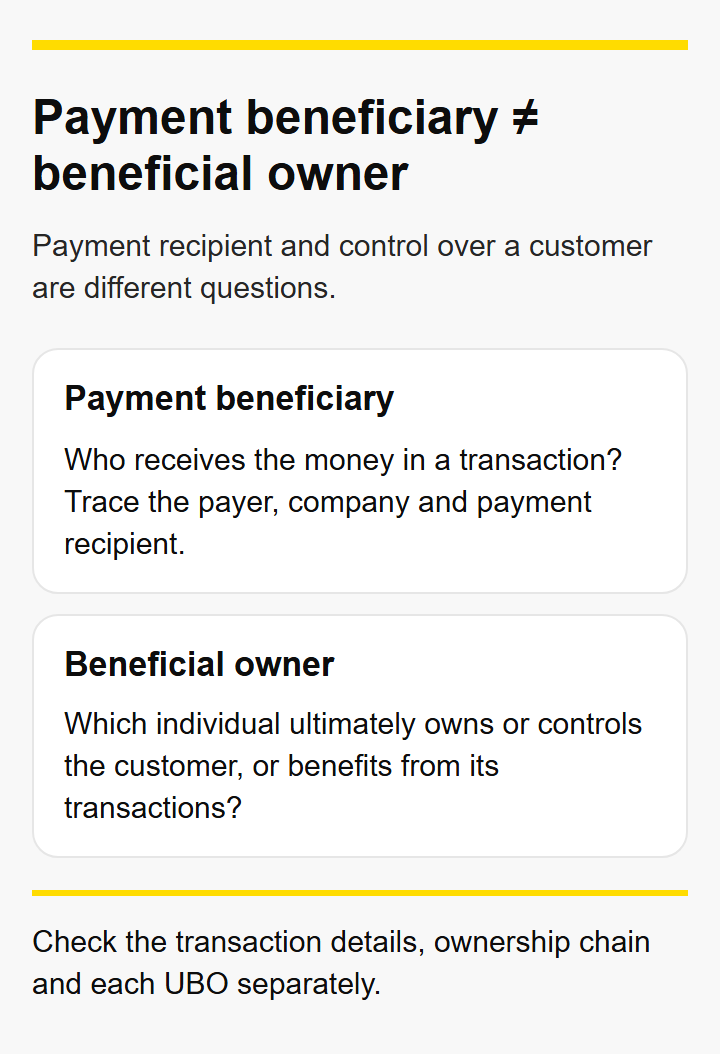
In Kazakhstan’s payment context, a “beneficiary” receives money. Under the AML/CFT Law, a “beneficial owner” is always an individual who directly or indirectly owns more than 25% of a customer’s shares or interests, controls the customer in another way, or in whose interest the customer carries out transactions. Checking the recipient’s bank details therefore does not reveal a company’s ultimate beneficial owner (UBO).
At a glance
A payment beneficiary can be a person or a company: it is the recipient of a particular transfer.
A beneficial owner is an individual behind the customer’s ownership, control, or benefit structure.
The more-than-25% threshold is important but not the only test; control may exist without that share.
The state register aids checks but does not remove the duty to understand the structure and resolve conflicts.
Screening of a company, director, and UBO should be kept as separate results.
One term describes two different relationships
The former Law on Payments and Money Transfers defined a beneficiary as the person identified in an order or demand as the recipient of funds. Current payment regulation retains the same operational logic: the beneficiary is defined by the direction of a particular payment.
A beneficial owner relates to the customer’s structure, not the payment arrow. The check seeks the individual behind corporate layers. That person may not receive the transfer at all. Conversely, a payment recipient need not own or control the sending company.
Question | Payment beneficiary | Beneficial owner |
|---|---|---|
Relationship | A payment or transfer | The customer’s ownership, control, or benefit |
Who qualifies | An individual or legal entity | An individual only |
Where to look | Payment instruction and recipient details | Ownership structure, company records, register, and other sources |
Main risk | Incorrect or substituted recipient | Hidden controller, nominee structure, sanctions or PEP exposure |
When it changes | Transaction by transaction | When ownership, control, or the underlying facts change |
How the “more than 25%” test works
The register rules and Law No. 191-IV define three branches. An individual is a UBO if they:
directly or indirectly own more than 25% of the customer’s shares or interests;
otherwise exercise control over the customer; or
are the person in whose interest the customer transacts in money or other property.
The threshold cannot be the only filter. For example, two consecutive 60% interests give an individual 36% indirect economic participation: 0.60 × 0.60. That is above the threshold. Four owners with 25% each do not satisfy the “more than 25%” ownership test on their stakes alone. Yet a shareholders’ agreement, appointment right, power of attorney, or practical influence might show control by other means.
Calculating a percentage is an analytical technique, not a complete legal conclusion. A complex structure requires examination of share classes, votes, joint control, trusts or foreign arrangements, and current corporate documents.
Five steps to check a UBO
Step 1. Trace the chain to individuals
Record the customer’s direct owners and their interests. If an owner is a company, open the next layer. Keep a source and date for every link: an extract, charter, register record, contract, or another acceptable document.
Step 2. Calculate indirect participation
Multiply shares along each chain and, where justified, add one person’s economic participation across independent branches. Keep the underlying percentages as well as the total; otherwise the result cannot be checked after the structure changes.
Step 3. Examine control outside the equity chain
Look for appointment or removal rights over management, binding instructions, contractual influence, veto rights, and people on whose behalf management actually acts. A zero equity stake does not imply zero control.
Step 4. Compare the register with customer documents
Article 6-1 provides for a register of legal entities’ beneficial owners, accessible to authorities and entities subject to financial monitoring in specified cases. A register response is valuable, but a conflict with documents or actual control cannot silently be overwritten. Escalate and resolve it.
Step 5. Identify and check each UBO
Collect the prescribed details for each identified individual, verify identity, and perform applicable AML checks. Biometric.Vision AML Screening can check a UBO against its stated sanctions, PEP, and other sources and repeat monitoring. The service does not make the organization’s legal ownership determination for it.
A register does not turn due diligence into one query
The register makes structured information available. It cannot guarantee that each entry captures today’s actual influence. Updates may lag; a foreign chain, identifier error, or contractual control may not be apparent. Compare the response with the customer’s declaration and independent documents.
Four useful statuses are:
confirmed: sources agree and the UBO’s identity has been checked;conflict: the register, customer, or documents disagree;incomplete: the chain ends before an individual is found;no_ubo_by_ownership: no owner passes the threshold, so other control must be tested before the case is closed.
The last status matters: “no person owns more than the threshold share” is not the same as “no beneficial owner has been established.”
Evidence to retain
A reproducible UBO file includes an ownership chart with dates, primary documents, the indirect-interest formula, signs of other control, the register response, resolution of conflicts, individuals’ identifying details, and separate screening results.
Biometric.Vision Document Verification can strengthen a UBO’s document check by extracting fields, checking expiry, and inspecting technical image features. Remotely, linking that document to the person also requires separate Face Match and liveness checks. This establishes the identified UBO’s identity, not the ownership chain itself.
When to repeat a check
Scheduled review matters but may come too late. Event triggers include:
a new shareholder, participant, director, or signatory;
a new jurisdiction or intermediary company;
payment behavior inconsistent with the business profile;
recipient details that differ from the contracting party;
a new sanctions or PEP signal;
a register update or expired document;
a customer’s refusal to disclose the chain or provide proof.
The principle is to check the money recipient as a participant in a transaction and the UBO as the individual behind the customer. Sometimes they are the same person, but the system must not assume that. Separate data models and check results prevent an error hidden by the shared word “beneficiary.”
Sources
Kazakhstan’s AML/CFT/CPF Law No. 191-IV, articles 1, 5 and 6-1.
Rules for maintaining the register of legal entities’ beneficial owners.
Originally published in Russian. Adapted for English readers.
This article is for information only and does not replace advice from a qualified lawyer.
Ready to strengthen your customer checks?
500 free checks a month for a year · no card · no contract · no sales call.