Digital identification in Kyrgyzstan: where Tunduk ends and customer verification begins
Separate a Tunduk service response, digital document, 1:1 biometric comparison, and the organization’s customer decision.

Date checked: 23 September 2026.
A customer presents a digital document in Tunduk, and a financial service receives matching form details. That is not yet enough to establish the identity of the person before the camera. The document, government source, biometric comparison, and decision to provide service answer different questions. The mistake is particularly serious in remote onboarding, where no physical document is presented.
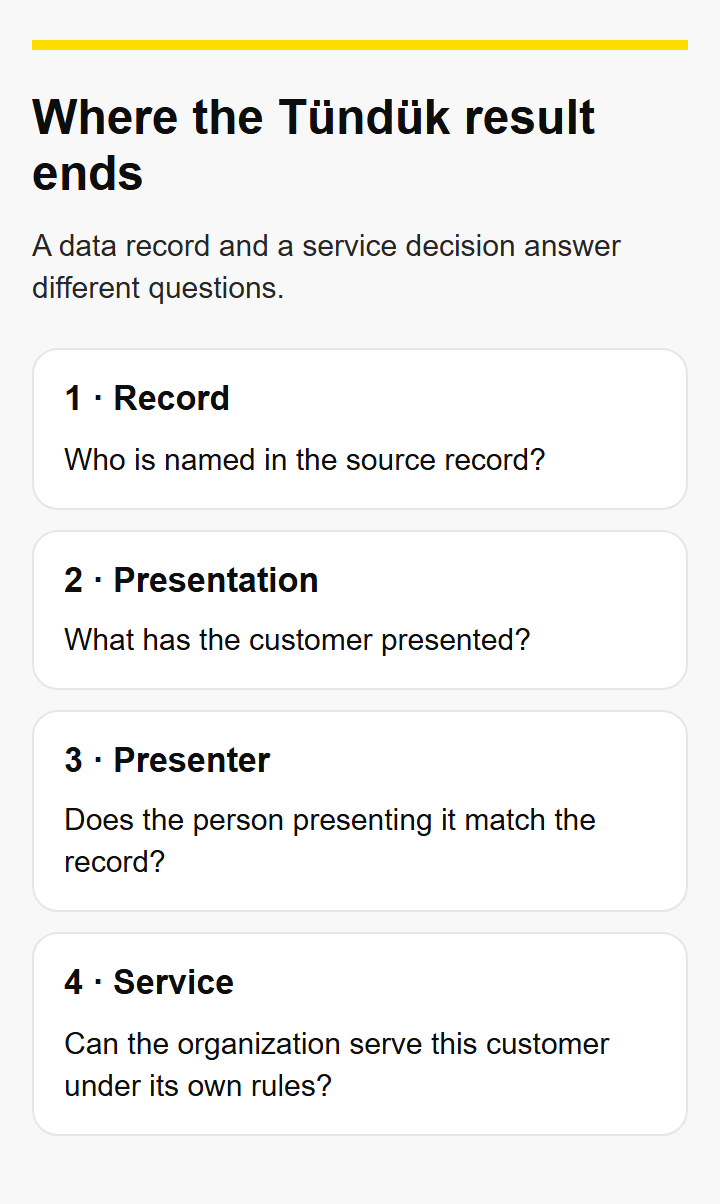
A working process should distinguish four results: where the details came from, whether the presented document is valid, whether the presenter matches the claimed holder, and whether this particular transaction can be completed.
Government infrastructure and a private service
Tunduk includes interagency exchange, a services portal, a mobile app, and a unified identification system. The government operator describes a separate process for organizations to connect. A customer having the app does not by itself give a business access to government data. The Ministry of Digital Development also describes a cloud electronic signature as a way to use the unified identification system for government services. Tunduk operator; ministry.
Article 48 of Kyrgyzstan’s Digital Code limits use of the state biometric system. Within its stated scope, data are compared with the biometric data of a particular person; searching one image across the entire government database for digital identification is prohibited. This rule cannot automatically be applied to every private biometric database. Establish the system owner, processing purpose, and applicable provision separately. Digital Code.
Decision matrix for a remote scenario
Question | Possible evidence | What it cannot establish |
|---|---|---|
Who is named in the record? | Response from an authorized government service | Who holds the phone now |
What was presented? | Digital document and source check | A business’s right to access all data |
Does the presenter match? | 1:1 comparison of a live selfie with a reference portrait | Absence of transaction fraud |
May the customer be served? | Sectoral rules, risk assessment, and organization decision | An automatic consequence of a face match |
Before implementation, a bank or other service should map exactly which Tunduk response it receives, on what ground, how it checks the presenter, and who makes the final decision. Each step needs a time, source, rule version, and outcome. If the government response is unavailable, the process should explicitly move to another permitted route, not treat a manual photograph as equivalent evidence.
Suppose a digital document is shown but no response arrives from an authorized government service. An operator should not record “document verified” from the phone screen alone. “Source unavailable” leaves room to retry, review manually, and explain a delay. In another case, the source confirms the details but the selfie fails a quality check. A new capture might resolve the technical problem; replacing weak evidence with an employee’s unchecked tick would break the link to the presenter.
Measure unavailable responses, repeated captures, and human decisions separately. Overall conversion does not show where a problem occurred. Link rule versions and access rights in the log to the particular session; months later, that is needed to explain why a customer used an alternative route.
The boundary of biometrics
Biometric.Vision Face Match describes a 1:1 comparison of a selfie with a document portrait. It can support the “presenter–document” link. It does not establish access to Tunduk, the document’s status in a government register, or compliance with sectoral law. Before launch, separately review the legal grounds for biometric processing and conditions for connection to government infrastructure.
Next step: draw one real customer-check route and mark the source and evidential limit of each result. Local legal counsel should then review that route for the specific sector.
Important qualification
This material is informational and is neither legal advice nor a finding that a particular process complies with the law. Rules and practice may change; before implementation, check current primary sources and sector rules with a local specialist. Biometric.Vision does not decide for your organization and is not responsible for decisions made solely on this article. Lawful data processing, control settings, and the final customer decision remain the organization’s responsibility. Mention of a product does not guarantee compliance.
Sources
Kyrgyzstan’s Digital Code, article 48, official register, checked 23 September 2026.
Tunduk operator, infrastructure and connection guidance, checked 23 September 2026.
Ministry of Digital Development: cloud electronic signature, checked 23 September 2026.
Originally published in Russian. Adapted for English readers.
Ready to strengthen your customer checks?
500 free checks a month for a year · no card · no contract · no sales call.