Egypt's Digital Financial Identity: How the eKYC Platform Changes Onboarding
Understand Egypt's new Digital Financial Identity framework: its scope, services, participant boundaries and the controls banks still need around eKYC.


Egypt's new Digital Financial Identity framework can remove the branch visit. The bank still has to decide. A reusable identity, an electronic consent and a successful authentication are three separate events, and if your system folds them into one green status, onboarding gets faster while the controls behind it get harder to explain.
On 23 August 2026, the Central Bank of Egypt approved rules for Digital Financial Identity (DFI) services and electronic customer identification and verification. The framework covers banks, licensed entities eligible to join the approved platform, authorised banking agents and other participating parties. It goes well beyond “selfie KYC”. The rules cover remote identity, data updates, transaction authentication, consent and identity sharing.
In brief
The CBE describes DFI as regulated infrastructure for individual customers, not a generic identity API open to any company.
The framework covers eKYC, electronic authentication, electronic acceptance of terms and DFI sharing through the approved platform.
Identification, verification, consent, authentication and an institution's product decision must remain separate records.
A platform response does not by itself complete AML risk assessment, sanctions screening or product eligibility.
Banks should map every platform event to its own control, owner, evidence and failure route before launch.
Biometric.Vision can supply components for a DFI onboarding flow. A connection to the CBE platform needs a confirmed integration and authorisation route; do not assume one exists.
What the CBE actually announced
The CBE's Digital Financial Identity page says the rules set minimum requirements for services delivered through the approved platform. It lists three service groups:
electronic customer identification, identity verification and identity-information updates;
electronic authentication of banking transactions, payment instructions and transfer orders, including acceptance of their terms and conditions;
sharing a Digital Financial Identity through the approved platform.
The rules apply to banks operating in Egypt, licensed entities that may join the platform and CBE-authorised banking agents. They also cover governance, participant responsibilities, technical and operational requirements, data protection and cybersecurity controls.
The CBE's release announcing the rules says customers will be able to open accounts and obtain banking services through digital channels without visiting a branch. It also describes electronic acceptance of terms, electronic authentication as an alternative to handwritten signatures and easier data updates.
Read these as statements of regulatory scope. They do not show that every institution, product or customer journey is already live, and they do not turn every technology provider into a platform participant. Publishing rules, approving participants, onboarding them technically and going live in production happen at different times.
One journey contains five different decisions
The most common architecture mistake is to treat DFI as one yes/no identity check. A design you can defend separates at least five objects.
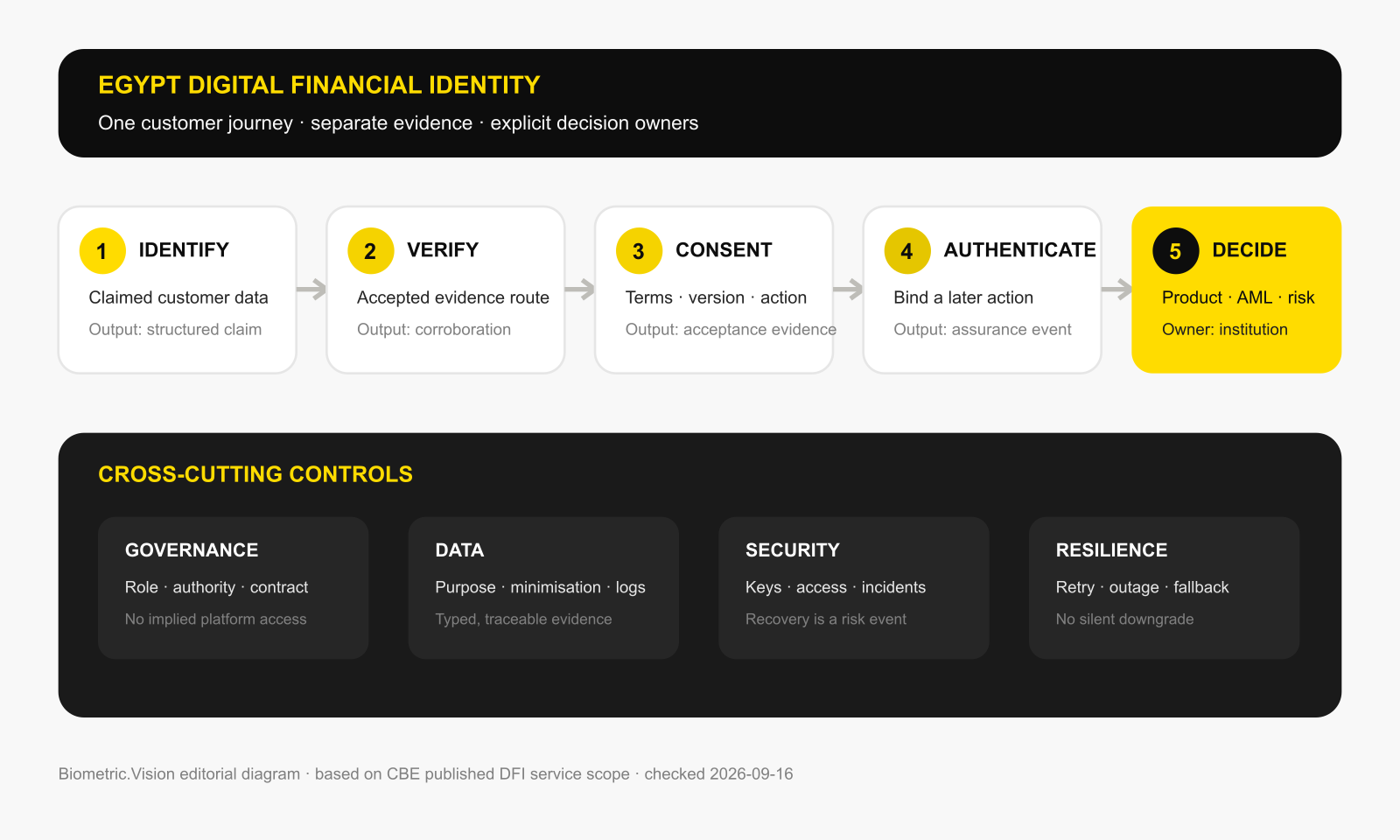
Object | Question answered | What it does not decide |
|---|---|---|
Identification | What identity data is claimed? | whether the claim is reliable |
Verification | Is the claim corroborated through accepted evidence? | whether the customer fits the product risk |
Consent | Did the customer accept identified terms? | whether the presenter is authorised for every future action |
Authentication | Is this action linked to the enrolled identity under the required assurance? | whether the transaction is legitimate in context |
Bank decision | May this customer obtain this product now? | whether future activity remains normal |
Keeping them apart stops a piece of evidence from being read as more than it shows. A successful authentication can show continuity with an enrolled credential, but it does not refresh an expired identity document. Valid consent does not cure a failed sanctions review. A verified identity says nothing about source of funds.
Map ecosystem roles before selecting technology
The published CBE summary confirms that governance and participant responsibilities are part of the framework. Before anyone designs screens or APIs, the implementation team should build a responsibility matrix from the full applicable rules and the approved participation model.
For each step, document:
who collects the customer's claim;
who performs or requests verification;
which participant returns the platform event;
who presents terms and captures consent;
who authenticates a later instruction;
who decides product eligibility and AML risk;
who handles exceptions, complaints and suspected fraud;
who retains each record and responds to regulator or customer requests.
A data-flow diagram will not answer these questions. “The platform checked it” names no accountable role. Contracts, platform rules and the bank's internal policies have to agree on who acts as controller, processor or in another applicable capacity, and on security duties, service levels and incident hand-offs.
Banking agents need the same explicit boundaries. The CBE puts authorised agents in scope, but the agent interface must not widen what the agent is allowed to do. Write down which evidence an agent may capture and which decisions it may communicate. Decide how a customer can tell an authorised channel from a fake one, and how assisted onboarding is protected against coercion or substitution.
Design the orchestration around evidence states
Your workflow should carry typed evidence. A single DFI_passed value hides too much. One workable state model:
claim received;
verification pending, verified, contradicted or unavailable;
consent text displayed, versioned and accepted;
authentication attempted, succeeded, failed or stepped up;
screening clear, possible match or confirmed escalation;
product decision approved, referred or rejected.
These labels are our suggestion; the CBE does not use them. They exist so that a timeout never turns into a negative result and an inconclusive biometric check never turns into a successful identity.
Each state change should keep its source, timestamp, request and response identifier, rule version and decision owner. Build for idempotency: a mobile retry must not create two identities, two consents or two accounts. Correlation identifiers should link the customer session, platform event and bank decision without writing unnecessary identity data into logs.
Biometric.Vision Orchestrator can coordinate conditional document, face, liveness and screening components. Treat it as workflow technology sitting around verified interfaces. It is no proof of access to the CBE platform, so confirm participation, integration, certification and data routes separately for each deployment.
Biometrics need a bounded job
Face comparison can bind a live capture to an accepted reference portrait. Liveness can detect the presentation attacks a given method covers, and document analysis can spot inconsistencies in an uploaded credential. The three work together, yet none of them is the DFI platform.
Before placing biometrics in the journey, specify:
the trusted reference and how it was obtained;
the capture channel and covered attack classes;
the threshold, quality floor and retry limit;
the outcome for accessibility or biometric exceptions;
whether images, templates, scores or only decision evidence are retained;
how a model or threshold change is approved and audited.
Biometric.Vision Face Match can compare a current face with a reference image. The institution still needs an authorised source for that reference and a policy for thresholds, exceptions and review.
Consent and authentication are lifecycle controls
Electronic acceptance should keep the exact terms shown, the language and version, when they were presented, what action the customer took and the evidence tying that acceptance to the authenticated customer. A checkbox stored without the text it refers to is weak evidence. A signature image is not automatically better.
Match authentication to the risk of the action. Viewing a balance, adding a beneficiary, changing a phone number and authorising a high-value transfer can use different controls. Decide when the system accepts the enrolled credential, when it asks for a second factor, when it triggers biometric step-up and when it stops the action.
Recovery needs its own threat model. If a fraudster can swap the registered phone or reset the credential with weaker evidence than you asked for at enrolment, strong onboarding counts for little. Tie recovery to trusted history, risk signals and controlled re-verification, and do not let pressure from customer support quietly lower the bar.
DFI does not replace AML and product controls
The platform can provide identity-related services. The institution still decides what extra due diligence applies to the customer, to the beneficial owner where relevant, to the product and to the transaction. Resolve identity before you screen names, keep the search parameters and list versions, and send plausible matches to controlled review.
For a general view of the wider control, see What Is KYC and How It Works. The next Egypt guide in this series separates bank KYC data collection, verification, AML risk assessment and decision evidence from the DFI architecture.
A launch checklist for banks and licensed participants
Confirm the entity's permitted role and production-access route under the CBE framework.
Trace every service to the current rule, contract, owner and evidence record.
Separate verification, consent, authentication, screening and product decisions.
Define unavailable, inconclusive, mismatch, suspected-attack and customer-support paths.
Test retries, duplicate messages, stale data and platform outages as well as the happy path.
Verify encryption, key ownership, log minimisation, access control and incident notification.
Give customers a usable correction, complaint and recovery route.
Reconcile platform events with bank records and investigate unexplained differences.
Prove that no fallback can turn a failed mandatory control into approval.
Egypt's DFI framework opens a regulated route to remote financial identity. The platform supplies defined services; each participating institution still applies its own legal and product controls and must be able to explain every consequential event. Before launch, pick any approval in your test logs and check that you can name the rule, owner and evidence that produced it.
Ready to strengthen your customer checks?
500 checks free every month · no card · no contract · no sales call.