Identity Verification in South Africa: Methods, Home Affairs and Cost
Compare South African identity verification methods, Home Affairs OVS fees, biometrics, manual review and the real cost per approved customer.


A one-rand database request can produce a more expensive onboarding than a ten-rand real-time check. The batch request may arrive too late for an applicant waiting at the sign-up screen, force a second session and send mismatches to a reviewer. The reverse also happens: paying for real-time Home Affairs data on every low-risk back-office refresh can waste money without improving a live decision.
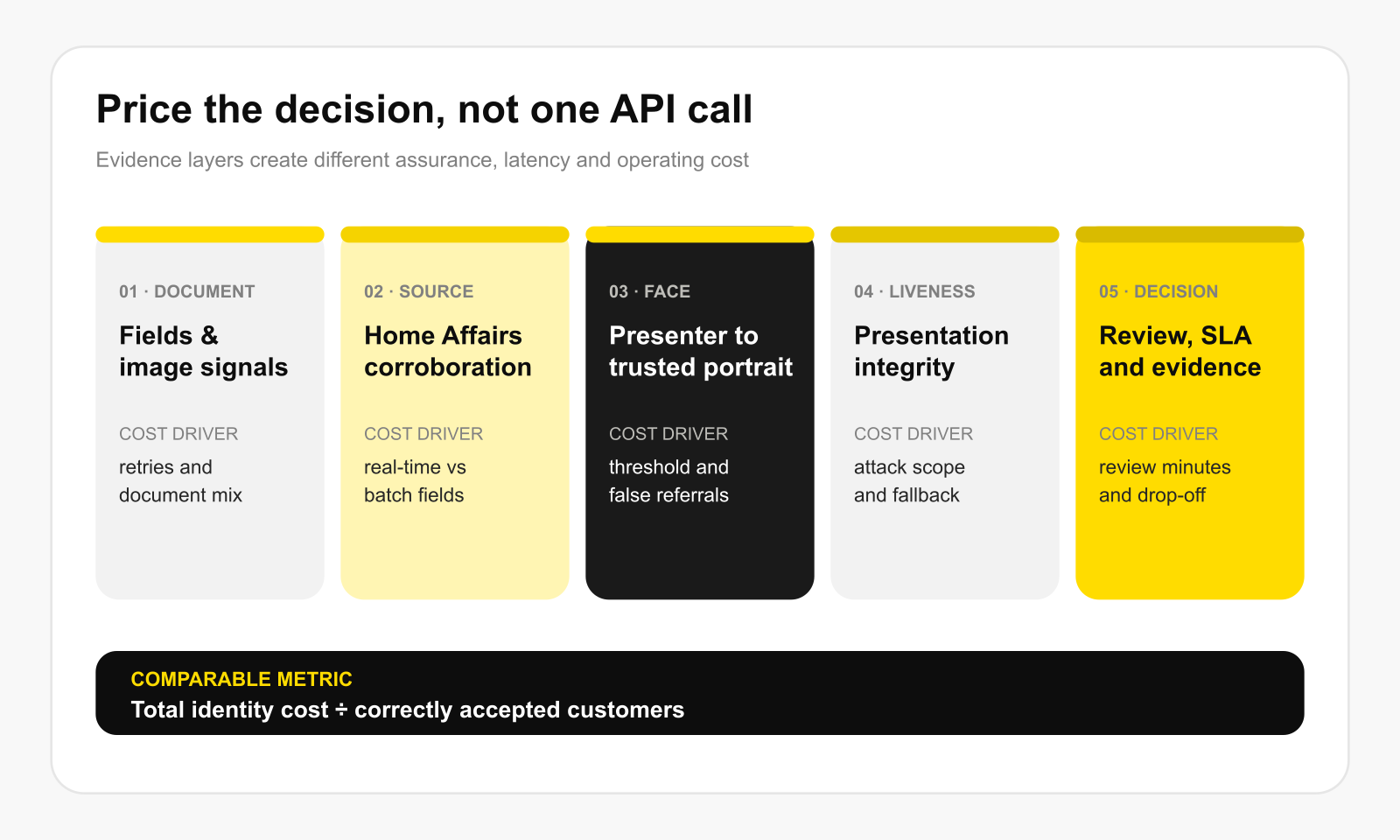
So “price per verification” is the wrong place to start. Your verification chain has to corroborate a claim, bind it to the presenter, detect attacks, resolve exceptions and retain evidence.
FIC Guidance Note 7 requires an accountable institution to choose identity information and verification means according to assessed ML/TF risk. This article compares methods and cost; the next guide covers the full FICA process.
In brief
Document OCR, document analysis, population-register verification, face matching and liveness are separate controls.
Home Affairs' Online Verification Service is an authoritative-source route for onboarded users, not an open public API that any vendor can promise.
The government-confirmed private-sector fee is R10 for a real-time OVS verification and R1 per off-peak batch field request; these are not complete eKYC prices.
A batch process is unsuitable where the customer needs an immediate decision, while a real-time call may be unnecessary for a scheduled portfolio refresh.
Manual review, retries, drop-off, fraud losses, integration and SLA often outweigh the headline API charge.
Compare providers on cost per accepted, correctly verified customer. Cost per attempted call misleads.
Start with the question each method answers
FIC Guidance Note 7 separates establishing identity from verifying it. Establishing means obtaining the customer's particulars; verification means corroborating them against documents or electronic data from reliable and independent third-party sources. A selfie shows a face but does not identify the person without a trusted reference.
ID document capture
The customer photographs a Smart ID Card, green barcoded ID book, passport or another accepted credential. OCR extracts fields; template, expiry, consistency and image-forensics checks can find some errors and tampering.
This works for documents outside the National Population Register route. Its limit is the source: a clean image can depict a stolen genuine document. Preserve data extracted, document signals, and document accepted as separate fields.
Home Affairs OVS
The Department of Home Affairs operates verification against the National Population Register. Its March 2025 upgrade notice described fingerprint and facial checks for government and financial-sector users. Its April 2026 update reported 99% uptime and real-time responses in seconds.
An OVS response corroborates information against an authoritative state source. It does not decide customer risk, remote-capture integrity or a sanctions match.
Access requires an authorised relationship and integration. The government description of online fingerprint verification shows banks receiving a verified/not-verified response while Home Affairs remains database custodian. Never imply OVS access unless the customer's route is confirmed.
Face match
Face matching compares a current portrait with a trusted reference and returns a similarity measure interpreted under a threshold. It does not prove that the document was state-issued or the camera feed genuine.
Liveness and capture integrity
Liveness tests whether the presentation is consistent with a live person and the attacks covered by the model. It should not override a low-quality face match or source mismatch.
Manual review
A trained reviewer resolves uncertain images, source mismatches and biometric exceptions. Each queue needs entry criteria, permitted evidence, escalation and quality checks. Without them, automation just moves the labour into another cost centre.
Build the method around the decision
Use case | Suitable evidence pattern | Main cost risk |
|---|---|---|
Live financial onboarding | document + real-time source where available + face + liveness | retries and false referrals |
Existing customer refresh | targeted source fields, often off-peak | requesting unnecessary fields |
Foreign national | passport and status evidence under the institution's rules | document diversity and manual review |
Account recovery | trusted historical channel + risk-based re-verification | attacker controlling the new channel |
High-value action | step-up biometric and transaction context | applying full onboarding again |
Repeating the same weak source creates correlated evidence. A document photo checked by two OCR engines is far weaker evidence than an independent population-register response plus holder binding.
What Home Affairs actually charges
The Department's June 2025 statement set the private-sector OVS fee at R10 for a real-time verification and R1 per field request in a non-live, off-peak batch. The April 2026 update confirmed the fee structure after the legal challenge was withdrawn.
Real-time OVS supports an immediate decision. Batch charging is field-based. Home Affairs illustrated this with an insurer that needed only the death field: one field cost R1 instead of requesting multiple available fields. Fingerprint was not available in the cited batch option.
These are government OVS charges to private-sector users. They are neither a Biometric.Vision quotation nor a total eKYC price. Connectivity, authorised access, vendor modules and internal operations remain separate.
Calculate cost per accepted customer
Use a cohort formula rather than adding list prices:
total identity cost ÷ correctly accepted customers
The numerator should include:
document, face and liveness sessions, including failed attempts;
Home Affairs or other authoritative-source requests and fields;
reviewer minutes, supervision and quality assurance;
SMS, device intelligence, storage and audit infrastructure;
engineering, vendor minimums, support and SLA;
customer-support contacts and abandonment after friction;
confirmed fraud loss and remediation attributable to missed attacks;
wrongful rejection cost and recovery for genuine customers.
Dividing an invoice by all starts understates retry and review cost per customer actually onboarded. Dividing only by successful API calls ignores abandoned and wrongly accepted sessions.
Track starts, completed sessions, final decisions and correctly accepted customers. A vendor can look cheapest on the first and most expensive on the last.
Model failure routes before comparing vendors
The normal path is easy to price. Exceptions determine operations:
unreadable or unsupported document;
valid document with source mismatch;
Home Affairs timeout or unavailable field;
face score near the threshold;
liveness or injection alert;
legitimate customer unable to use the biometric route;
duplicate identity or existing account;
customer dispute after rejection.
For each case, specify whether to retry, switch method, hold for review or decline. Record the maximum attempts and prevent a weaker fallback from overriding a stronger failed control. If a source mismatch falls back automatically to document OCR, the organisation paid for an authoritative check and then discarded its meaning.
Procurement questions that expose hidden cost
Ask each supplier to price the same test cohort and disclose:
What counts as billable: an attempt, completed module or final decision?
Are failed captures and retries charged?
Which South African and foreign documents were tested, and by what accuracy unit?
Is Home Affairs connectivity included, customer-supplied or unavailable?
Which source fields are requested, and why?
What proportion enters manual review under proposed thresholds?
Who operates review, at what hours and SLA?
How are false decisions and presentation attacks measured?
What evidence is returned for audit and disputes?
What are retention, hosting, minimum-volume and exit costs?
Do not compare one provider's OCR-only price with another provider's document, face, liveness and review bundle. First normalise the evidence and decision policy.
Where Biometric.Vision fits
Document Verification extracts fields, validates MRZ where present and analyses declared document-image signals. Face Match compares the presenter with a reference portrait, while Liveness returns a separate presentation result. The broader method is explained in the existing guide What Is KYC and How It Works.
Biometric.Vision does not claim automatic access to South Africa's National Population Register on these product pages. Treat Home Affairs OVS as a customer-specific external source integration unless a confirmed arrangement states otherwise. The institution still owns accepted documents, thresholds, fallback, FICA risk logic and the final decision.
Run a representative pilot before adopting a unit price. Include genuine customers across document types and devices, known attack samples, OVS outages, near-threshold faces and accessibility cases. Report completion, review, false decision and total cost by route. Those figures give you an identity verification cost you can defend, built from your own operations instead of a vendor's list price.
Sources
Ready to strengthen your customer checks?
500 checks free every month · no card · no contract · no sales call.