How to identify a beneficial owner in Azerbaijan
Who qualifies as a beneficial owner in Azerbaijan, how to check ownership and control in order, and what evidence to retain.


Three legal entities own a company, and its director signs a bank agreement. None of these facts alone answers the central AML question: which individual ultimately owns or controls the structure or benefits from its transactions? Checking the first-layer shareholder stops short of an answer.
Azerbaijan’s Financial Monitoring Service defines a beneficial owner as the individual who ultimately controls a customer, is its actual owner, in whose interest a transaction takes place, or exercises effective control over a legal entity or foreign legal arrangement. The check follows a sequence: a substantial ownership interest, control by other means, and then the statutory fallback.
At a glance
A beneficial owner is an ultimate individual, not an intermediary company.
The payment recipient, director, signatory, and ultimate beneficial owner (UBO) may be four different people.
Start with ownership, but assess other actual control too; a percentage is not the whole test.
Corroborate customer information against reliable independent sources and resolve discrepancies.
Screen every identified individual, not just the company name.
Four roles often mistaken for one beneficiary
Role | Meaning | Why it is not automatically the UBO |
|---|---|---|
Payment recipient | Receives money | One payment does not prove company control |
First-layer founder | Directly owns an interest | Could be another company with individuals behind it |
Director or signatory | Manages or acts for the company | Authority may be employed and limited |
Beneficial owner | Ultimate individual owner, controller, or beneficiary | Found by analyzing the full structure and practical influence |
The banking account-opening rules require identification and verification of a new corporate customer to continue until the bank is fully satisfied that it has established the identity of all individual beneficial owners.
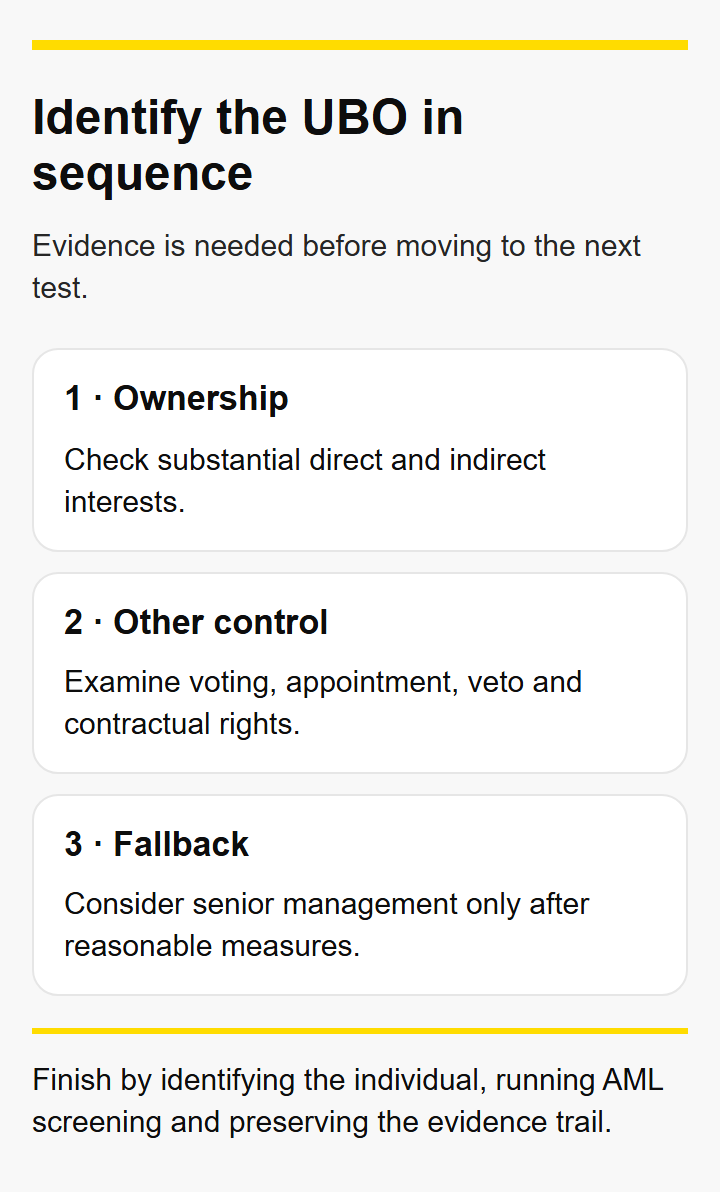
Check in sequence: ownership, control, management
1. Find individuals with a substantial interest
Trace ownership from the customer through all intermediary legal entities to people. For each link, record the percentage, voting rights, jurisdiction, source, and date. If one person participates through several branches, calculate direct and indirect influence along each.
Do not import a percentage threshold from another country. An Azerbaijani check must use the current definition of “substantial interest” and sectoral rules for the organization concerned.
2. Check control by other means
If no owner qualifies by interest, or if formal ownership may not reflect real control, examine appointment rights, binding instructions, contractual vetoes, funding, powers of attorney, concerted action, and actual management.
Zero equity does not mean zero control. Conversely, a large stake may not explain all control if rights have been transferred by agreement.
3. Apply the fallback
If reasonable measures cannot identify an individual through ownership or other control, apply the statutory procedure concerning a person in a senior management position. This does not make a director the “real owner.” Retain their details alongside evidence of the measures tried and why the earlier routes did not identify a UBO.
Build a verifiable chain
At each node, answer five questions:
who directly owns the interest or vote;
which document proves it;
who is in the next layer;
whether there are signs of control beyond ownership;
when the information was checked and what triggers an update.
Sources may include government registers, company records, official extracts, and other reliable independent resources. The customer’s declaration is a starting point, not sole proof.
Under the current state-registration law, Azerbaijan provides register mechanisms for legal entities’ beneficial-owner data and their verification by the Financial Monitoring Service. A register entry does not remove the need to analyze conflicts. If documents, the register, and real influence disagree, the case cannot be closed by automatically choosing one source.
What to check after finding an individual
Establishing a UBO, identifying the person, and verifying them are distinct steps. Record the prescribed identifying details, check the document, and apply sanctions, PEP, and other risk screening.
Biometric.Vision AML Screening checks people and companies against its stated sanctions, PEP, and other lists, supports repeat monitoring, and saves results. It does not calculate the legal ownership chain for an organization or decide whether particular influence amounts to effective control.
For a remotely presented UBO document, Document Verification can extract fields and inspect technical image features. Face Match and liveness separately connect the document to its presenter. These technical results establish the identity of a person already found; they do not prove ownership or control.
Four working statuses instead of “UBO checked”
confirmed: the chain reaches an individual, sources agree, and identity and risk have been checked;conflict: customer, documents, or register disagree;incomplete: the chain stops at an intermediary company or foreign arrangement;senior_manager_fallback: the management fallback followed documented reasonable efforts.
The last status must not look like ordinary confirmation of ownership. It records a limit of the check and may affect risk and the need for enhanced measures.
Events that trigger another check
An annual calendar alone is insufficient. Review when a shareholder, director, or signatory changes; a new jurisdiction appears; voting rights change; a transaction is atypical; recipient details conflict; a new sanctions or PEP signal arrives; or the register is updated. Define the owner, deadline, and scope of each review.
A reproducible UBO file contains an ownership chart, primary sources, indirect-interest calculations, signs of other control, resolved discrepancies, personal details, screening results, and grounds for the final decision. It shows not only a UBO’s name, but how the organization arrived at it.
Sources
Azerbaijan’s Financial Monitoring Service: beneficial-owner FAQ.
Financial Monitoring Service: methodology for identifying beneficial owners.
Central Bank: rules on opening, maintaining and closing bank accounts.
State Registration and State Register of Legal Entities Law, article 14-1.
Originally published in Russian. Adapted for English readers.
This article is for information only and does not replace advice from a qualified lawyer.
Ready to strengthen your customer checks?
500 free checks a month for a year · no card · no contract · no sales call.