Who is subject to financial monitoring in Kazakhstan?
How to determine whether a Kazakhstani organization is subject to financial monitoring and turn that status into KYC, AML and internal-control duties.


A company launches a product, connects customer checks, and considers its AML work complete. Its first check, however, should concern the company itself: is this legal entity and its actual activity within a category subject to financial monitoring under article 3 of Kazakhstan’s AML/CFT Law?
Getting this wrong changes the entire control system. An organization might configure sanctions screening without defining its internal-control rules, reporting route, or responsible role. The reverse error is to treat a group’s technology contractor as a regulated entity merely because it serves a bank or microfinance institution.
Status follows the law and actual activity, not the words “KYC,” “fintech,” or “platform” in a presentation. The method below links a service, legal entity, exact subparagraph of article 3, sectoral act, and evidence for the conclusion. It is no substitute for a legal opinion, but it prevents automation from starting with the wrong assumption.
At a glance
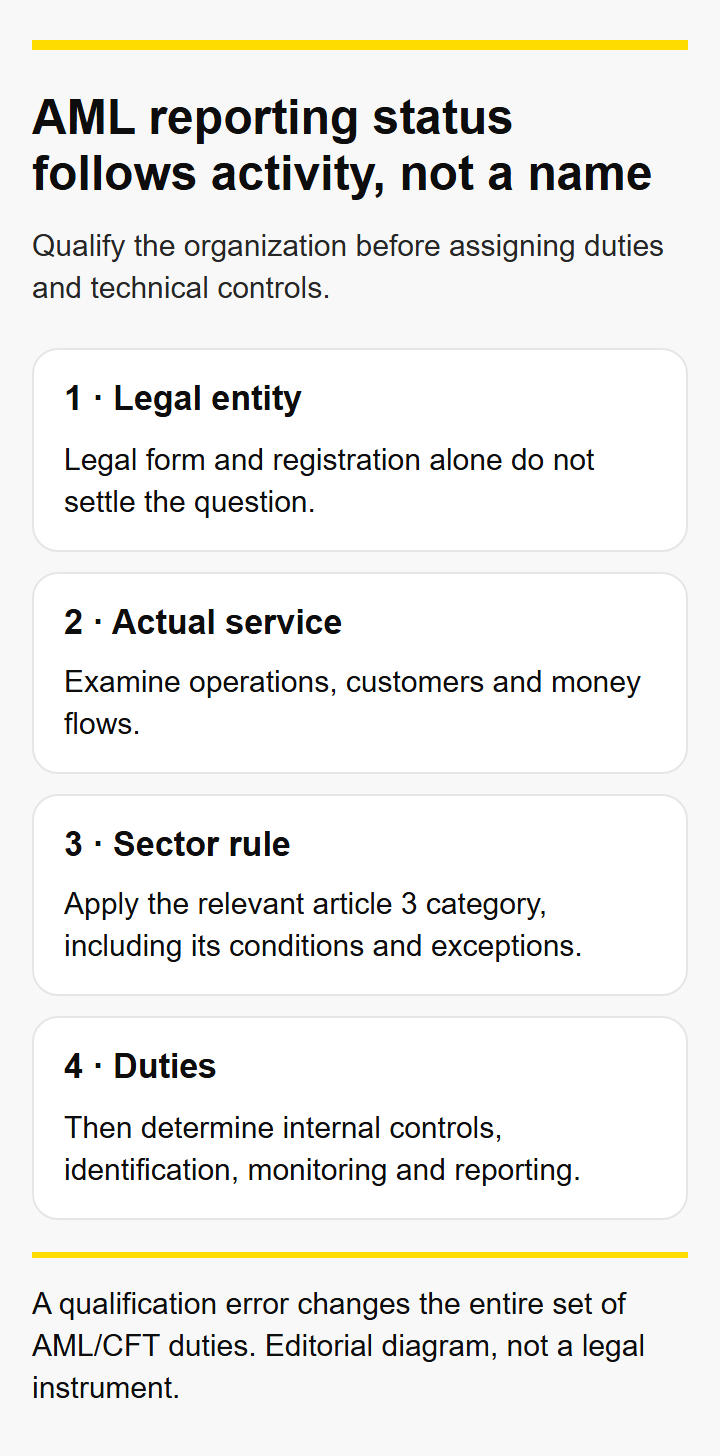
Classify each legal entity by what it actually does.
Compare the category with the current article 3 and the sectoral act.
Then map duties, owners, and evidence.
An AML service performs checks but does not determine an organization’s legal status.
One brand or group interface does not make every legal entity the same regulated party.
Article 3 has conditions as well as category names
The article 3 text current when checked contains a broad list. Five groups help initial navigation, but a legal conclusion always needs an exact subparagraph.
Group | Categories named | What else to check |
|---|---|---|
Financial market | Banks and branches of nonresident banks, specified banking organizations, exchanges and clearing, insurers and their nonresident branches, pension funds, securities professionals, central depository, microfinance and payment organizations | Precise role, licence, exceptions, and sectoral regulator |
Professional services | Notaries; lawyers, legal consultants and other independent professionals; accounting and audit firms; self-employed professional accountants | For legal specialists, whether they carry out one of the expressly listed transactions for or on behalf of a client |
Property and valuables | Unlicensed lessors, precious-metal and gemstone businesses, real-estate intermediaries | Who concludes the transaction and the company’s role |
Special sectors and infrastructure | Gambling and lotteries, postal operators transferring money, social health insurance fund, certain AIFC participants, government service corporation, mobile operators | Particular duty scope and subordinate rules |
Digital assets | Unbacked-asset exchange operators, digital-financial-asset and trading-platform operators, issuers, and participants in the National Bank’s special regime | Asset type, permitted activity, and each participant’s status |
The list cannot be reduced to “banks and microfinance,” nor expanded by resemblance. A legal consultant, for example, is covered under article 3 when acting for or on behalf of a customer in specified transactions: real estate, management of money or accounts, raising funds for a company, or creating, buying, selling, or managing a legal entity. The profession alone is not the test.
There is a procedural distinction too. Article 3 requires notices when activity begins or ends from specified subcategories, not all regulated entities: legal consultants and other independent specialists except advocates, unlicensed lessors, precious-metal and gemstone businesses, and real-estate intermediaries. A single checklist “for every regulated entity” therefore fails at the first step.
Four evidential steps to establish status
Break the business into services. Name payment acceptance, intermediation, lending, asset exchange, custody, and customer checks rather than just “marketplace.”
Name the provider of each service. Record the legal entity, contractual role, licence, territory, and actual conduct.
Match activity to a provision. For each candidate, identify the law’s subparagraph, inclusion condition, exception, and sectoral act.
Record the decision and review trigger. Keep the edition date, opinion’s author, and events that require renewed classification.
If a group has several legal entities, classify them separately. A shared platform does not merge them or move obligations from a licensed participant to its technology contractor.
The key outcome is a service × legal entity matrix, not one status for the whole brand.
Service | Contracting entity | Transaction role | Possible article 3 subparagraph | Evidence |
|---|---|---|---|---|
Payment acceptance | Company A | Payment organization | 12 | Licence, contract, and actual money flow |
Document check | Company B | Technology contractor | Does not follow from the list alone | Processing contract and absence of a regulated transaction in its own name |
Real-estate sales intermediation | Company C | Intermediary | 16 | Contract subject and actual role in the deal |
These are method examples, not ready-made classifications of particular companies.
Three borderline cases expose a rushed checklist
A group with a common platform. A bank contracts with a customer while a separate IT company supplies the interface and computing infrastructure. Serving the bank is not itself a listed ground under article 3. The conclusion changes if the IT company actually supplies a regulated service in its own name. Examine contract, licence, and real transaction flow, not only the company’s name.
A law firm. Preparing an ordinary legal opinion and managing a customer’s money are different facts. For the relevant article 3 category, acting for or on behalf of a customer in a closed list of transactions matters. The file should show the service performed and the specialist’s role.
A platform with several roles. One interface may join a seller, payment organization, digital-asset operator, and KYC contractor. Status belongs to legal entities, not an interface. Allocate contractual and actual roles first, then test each party against article 3.
In all three cases, the result may be a list of missing evidence rather than a simple yes or no. That makes the next check visible before launch.
After classification, map duties instead of copying an AML checklist
The AML/CFT Law links regulated status to customer, representative, and beneficial-owner due diligence, transaction monitoring, and internal controls. Methods, forms, and sectoral rules differ by category. Map what applies before buying a system.
The map should cover:
identification and identity checks;
the representative’s authority and ultimate owner;
customer and relationship risk;
applicable lists and PEP checks;
transaction monitoring and escalation of suspicion;
reporting to the Financial Monitoring Agency where required;
retention of decision evidence and staff training.
Automating one check does not remove responsibility for the final decision. A list hit needs review; no hit does not settle the risk of an unusual transaction.
Connect six elements in a working map:
Element | Question | Output |
|---|---|---|
Provision | Which article and sectoral act apply? | Link to current edition |
Event | What starts the duty? | Onboarding, transaction, risk change, or list update |
Check | What data and actions are needed? | Identification, UBO, screening, or transaction review |
Decision | Who decides under what rule? | Automated route or human escalation |
Report | Must information be sent, and how? | Responsible channel and deadline control |
Evidence | What makes the decision reproducible? | Source data, rule version, result, and decision-maker |
An API does not itself fulfil a law. It may return a match, but cannot identify the applicable provision, approve internal-control rules, or make the regulated party’s final decision.
A classification file should withstand inspection
Keep a conclusion on status as a small managed document, not just one lawyer’s email. A minimum structure could be:
Field | Record | Review trigger |
|---|---|---|
Legal entity | BIN, licence, regulator, and place of business | Reorganization or new licence |
Actual service | Parties, money or property, and company role | Product launch or model change |
Rule | Article 3 category, sectoral act, and exceptions | Legal amendment |
Conclusion | Status per service and limits of conclusion | Broader activity |
Consequences | Internal-control rules, responsible roles, checks, and reports | Process or system change |
Outsourcing technology does not automatically transfer legal status. A supplier may check documents or lists, but the organization to which the duty applies retains classification, approval of internal-control rules, and regulatory decisions. Its supplier contract should specify input data, response contents, source updates, error handling, evidence retention, and outage procedures.
Where an AML service’s task ends
Biometric.Vision AML Screening describes checks of individuals and companies against the sanctions, PEP, and other lists stated on its page, repeat monitoring, and result logging. These can be combined with document, face, and liveness checks in one eKYC flow.
The service does not determine a company’s regulated status, a customer’s risk category, or a reporting duty. Those decisions belong to internal-control rules and responsible staff. Before integrating, draw a “rule → event → check → decision → evidence” matrix. It reveals where automated screening is useful and where legal classification or human escalation is needed.
This material is informational. For a borderline activity, confirm the conclusion with a Kazakhstan legal specialist and keep the underlying facts in the file alongside the opinion.
Originally published in Russian. Adapted for English readers.
This article is for information only and does not replace advice from a qualified lawyer.
Ready to strengthen your customer checks?
500 free checks a month for a year · no card · no contract · no sales call.