Beneficial owners in Moldova: how to identify and declare them
Moldova’s 25% plus one share test, control by other means, three-source verification, and declarations and updates to ASP.


Consider a Moldovan company: one participant owns 24% of its capital and three legal entities divide the remaining 76%. No visible participant passes 25%. Yet a financing contract lets the first participant block the budget, replace management, and determine major transactions. A percentage-only check would report no beneficial owner precisely where an individual actually controls the business. The example illustrates the warning in official guidance on control by other means.
The guidance of Moldova’s Office for Prevention and Combating Money Laundering (SPCSB), updated by Order No. 9 of 29 May 2025, requires examination of direct and indirect ownership and other control. The 25% plus one share threshold is the first test, not a safe harbor. An administrator may be named as a fallback only after all possible identification methods have been exhausted, with no grounds for suspicion and a record of the steps taken.
At a glance
The beneficial owner is an individual who ultimately owns or controls the customer or in whose interest a transaction takes place.
For a commercial legal entity, check direct and indirect ownership above 25%, then control by other means.
The threshold does not remove the need to assess voting, management appointments, financing contracts, and actual influence.
A reporting entity should corroborate information using at least three sources: customer, public register, and another reliable independent source.
The 31 December 2025 transitional deadline has passed; later changes must be reported within 30 days.
A state-register entry helps but does not replace the entity’s own due diligence.
Separate two duties first
A legal entity’s duty to file information with the Public Services Agency (ASP) is often conflated with a bank’s, payment organization’s, or other reporting entity’s duty to establish and verify a customer’s beneficial owner. The responsible parties and evidence differ.
The legal entity files a declaration so information appears or is updated in the State Register of Legal Entities. A reporting organization uses that register as one source but makes its own decision under Law No. 308/2017 on preventing and combating money laundering and terrorist financing. Declaration accepted must not automatically become CDD complete.
From ownership to actual control
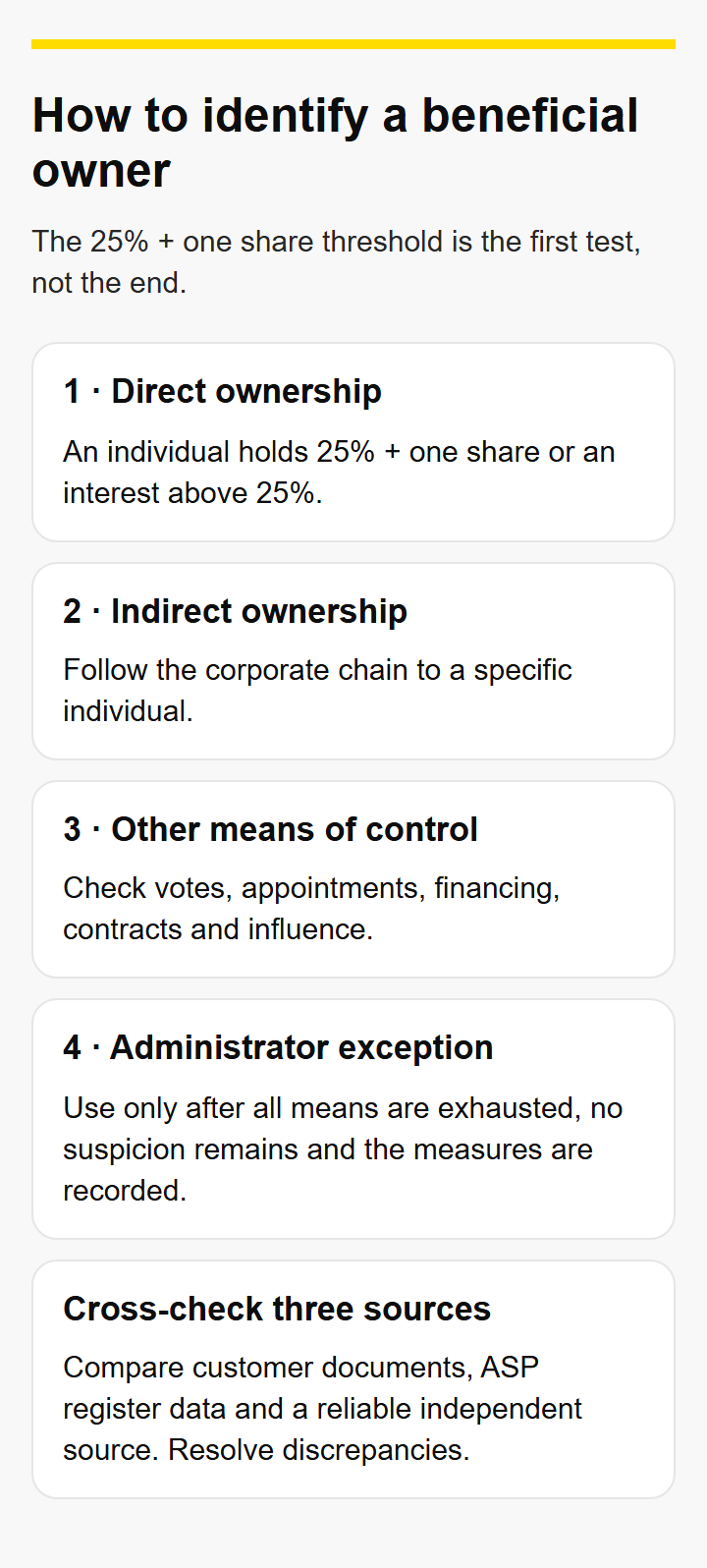
Step 1. Disclose direct ownership
For a commercial legal entity, the guidance describes direct ownership as an individual holding 25% plus one share or an interest above 25% of capital. A capitalization table needs more than a name and percentage: record the interest class, voting rights, date, supporting document, and source.
Exactly 25% of capital and more than 25% must not be casually equated. The guidance’s wording refers to 25% plus one share or an interest exceeding 25%. Record how that test applies to the entity’s legal form in internal methodology and agree it with counsel.
Step 2. Follow the indirect ownership chain
When a shareholder is a company, continue until an individual is found. In a calculation example, owning 60% of an intermediary that owns 50% of the customer gives a 30% indirect interest. This illustrates the chain method in official guidance, not a separate statutory example. The arithmetic must not conceal agreements among participants, nominee ownership, or concerted action.
For each node, retain a registration extract, constitutional documents, shareholder register, and date of currency. A chart without sources is an illustration, not evidence.
Step 3. Examine other means of control
The guidance expressly warns that ownership is not the only route to a beneficial owner. Signs of other control may include:
a majority of votes or stable influence over general-meeting decisions;
the power to appoint or dismiss most managers;
decisive influence through a loan, pledge, or other financing agreement;
the power to set budgets, strategy, or major transactions;
management without a formal position;
actual influence through family, social, or business relationships.
One sign does not alone prove ultimate control. Connect the right to a document, assess whether it can actually determine the customer’s actions, and record reasons for and against the conclusion.
Step 4. Use an administrator only as a fallback
If no individual can be identified after exhausting all possible means and there is no ground for suspicion, the legal entity’s administrator may be named as the beneficial owner. This is not a shortcut through a complex structure.
The file should retain sources searched, questions sent to the customer, gaps found, reasons why a controller could not be established, and a separate suspicion assessment. If the structure is opaque, documents conflict, or the customer evades questions, the no-suspicion condition has not been met. Enhanced analysis and escalation under internal rules are needed, not an automatic fallback.
The three-source rule
Updated SPCSB guidance requires at least three sources:
information and documents from the customer;
public-register data;
another reliable, independent source.
Choose the third source according to structure and risk: constitutional documents, shareholder records, audited statements, minutes, a trust deed, regulated-exchange disclosure, or a competent authority’s records. A commercial database may help find a connection, but an entry without provenance or date should not be treated as independent confirmation.
Keep a discrepancy matrix as well as the final name:
Fact | Customer | Public register | Independent source | Decision |
|---|---|---|---|---|
Individual’s identity | Document and form | ASP details | Permissible external source | Match or escalation |
Interest and chain | Customer chart | First-layer participants | Charters, registers, statements | Indirect-interest calculation |
Other control | Declaration | Often lacks the whole mechanism | Contracts, minutes, financing | Reasoned conclusion |
Currency | Confirmation date | Extract date | Document date | Next review date |
What to file with ASP, and when
The ASP FAQ says the register includes name, date of birth, state identifier, home address, country of residence, nationality, and nature of the beneficial interest. The relevant BE form depends on entity type and event: initial declaration, change, or another prescribed situation.
ASP’s 8 October 2025 reminder concerned a transitional filing and updating deadline of 31 December 2025. It is not an annual deadline every 31 December. The continuing rule after a change is to report it within 30 days.
ASP accepted documents in person through multifunctional centers or remotely through its specified channel with a qualified advanced electronic signature. Before filing, check the current form and channel on ASP’s site; the technical route can change faster than the disclosure rule.
Identifying the individual found
A name in an ownership chain is insufficient. Link the details to a particular person and check against a reliable source. Remotely, separate results generally include:
document reading and verification;
a liveness check of the presenter;
matching the current face with the document portrait;
sanctions and PEP screening with potential-hit review;
a record of why the person was classified as a beneficial owner.
Biometric.Vision Document Verification extracts fields and checks document features; AML Screening screens a person or company against connected lists and supports repeat monitoring. These modules do not build the ownership chain for the customer, automatically obtain ASP records, or decide whether a particular agreement creates control. The reporting organization makes that determination.
An audit trail another analyst can use
Keep four layers for each decision:
Structure: entities, percentages, votes, control agreements, and document versions.
Identity: identifiers, source, check date, and resolution of matches.
Decision: test applied, calculations, other control, author, and approval of an exception.
Lifecycle: declaration date, 30-day change deadline, next review, and unscheduled triggers.
Triggers include more than changed percentages. A new administrator, a creditor with special rights, a shareholder agreement, address, nationality, or PEP status may change risk or the control conclusion.
A simple quality test: could another analyst reconstruct the route from first-layer shareholders to an individual and see why other candidates were excluded? If all they see is a name and green status, a beneficiary has been recorded but the decision has not been evidenced.
Sources
SPCSB beneficial-owner guidance, amended by Order No. 9 of 29 May 2025.
Moldova’s Law No. 308/2017, official text (legis.md, in Romanian).
Originally published in Russian. Adapted for English readers.
This article is for information only and does not replace advice from a qualified lawyer.
Ready to strengthen your customer checks?
500 free checks a month for a year · no card · no contract · no sales call.