Belarus’s interbank identification system: how MSI works
Who supplies Belarusian MSI data, how a service receives verified customer details, and which checks remain with the bank or business.


A customer has already been identified by one Belarusian bank. Can another bank or digital service open a product without another visit and new photos of every document? The interbank identification system, MSI, allows previously obtained and verifiable information to be used remotely. Its response does not relieve the recipient of checking currency, assessing risk, and recording its own decision.
MSI is neither a payment system nor BISS. Under Presidential Decree No. 148, it enables remote identification without physical presence, authentication, and verification of customer data. The owner and operator is NKFO ERIP, an open joint-stock nonbank financial organization. National Bank Instruction No. 497 sets detailed interaction rules.
At a glance
MSI transfers identity information through a defined system; it does not settle interbank payments.
Participants and, where prescribed, government information resources supply the data.
An MSI user obtains information after connecting and on a permitted ground, not from an open database.
Authentication to a record, data currency, and permission to provide a product are separate decisions.
Biometrics can strengthen a remote route but does not replace an MSI response or compliance checks.
Four roles that must stay distinct
Decree No. 148 and Instruction No. 497 distribute the process among several parties.
MSI owner, NKFO ERIP. It builds the system, processes and protects data, and supplies them under the prescribed procedure.
MSI participant. A bank or other eligible organization supplies details obtained during identification and updates.
MSI user. A connected organization asks for details for a permitted remote procedure and uses them in its own process.
Customer. The customer registers and authenticates, provides the required confirmations, and receives a service.
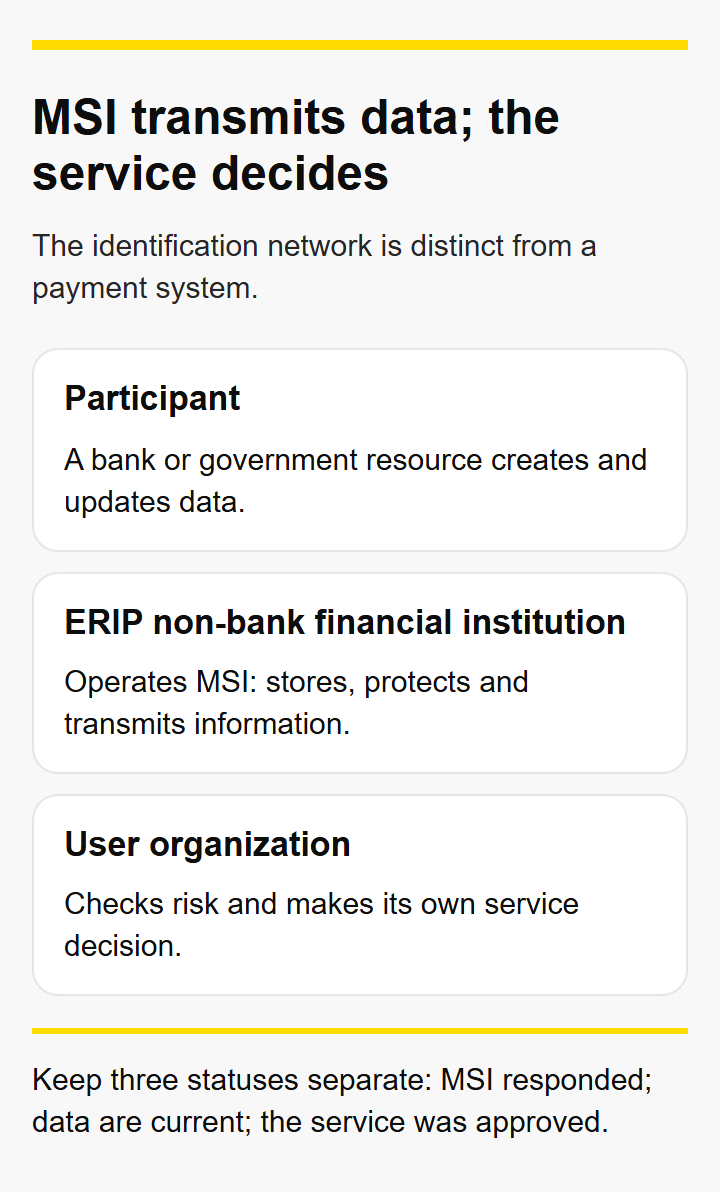
An organization can be both participant and user, but the roles remain distinct. When supplying details, source quality and updates matter; when receiving them, the lawful purpose, customer match, and its own decision matter.
What happens in a remote application
The interface varies by service, but the evidential logic is similar.
1. The service starts a session and directs the customer to MSI
The log needs session and request IDs. A redirect to a familiar page does not mean identification succeeded. A verifiable response tied to the current session does.
2. MSI authenticates the customer
Authentication asks whether the subject associated with a record has gained access. MSI development includes scenarios with biometric documents and interaction with a unified system identifying individuals and legal entities. The chosen method must suit current rules and the risk level.
3. The user receives the prescribed data
A system response is stronger than a photograph of a form because it has a source and timestamp. It should not silently expand the processing purpose: the organization obtains only the details it needs and retains them within its legal ground and period.
4. The organization checks product restrictions
MSI confirms data and an identification route; it does not decide whether a particular product may be opened. AML checks, risk assessment, age and contractual limits, representative authority, and sectoral requirements remain.
5. The system records its own final decision
Keep msi_success separate from service_approved. Sanctions screening, phone confirmation, biometrics, or human review may sit between them. Otherwise a later investigation cannot tell whether MSI or a business rule refused the customer.
Reusing data does not mean permanent identification
Details change: a document expires, a name or address changes, or a company director loses authority. “The customer is in MSI” is not permanent proof of every field.
For each attribute, keep:
Evidence field | Checkpoint |
|---|---|
Source | Who supplied or confirmed the detail? |
Time | When was it received and updated? |
Currency | Is its age acceptable for this product? |
Session | Is the response tied to this user and request? |
Decision | Which rule permitted or stopped the service? |
This is a suggested log model, not a verbatim form from Instruction No. 497. It separates a system response from the business’s interpretation.
When additional biometrics is useful
A biometric step may be justified when a particular route requires linking the current presenter to a portrait from a reliable source or when risk increases. Face Match tests similarity to a reference; liveness tests signs of live presence. Neither confirms that every MSI field is current.
Biometric.Vision Orchestrator can join a system response, liveness, Face Match, and AML checks in one route. Biometric.Vision is not MSI’s operator and does not claim direct integration on its product page. An organization connects to the Belarusian system under the prescribed conditions.
MSI, BISS, and ERIP are different
“Interbank” in the name causes confusion. BISS handles interbank settlement. ERIP is widely known as a settlement system, while NKFO ERIP also owns MSI. MSI transfers and verifies identifying details; it does not move funds between banks.
Ask what the process produces: an identified subject and data set, or an executed payment? The first may involve MSI; the second concerns payment infrastructure.
Checklist for a bank or service
Before launching a remote flow, establish:
the organization’s role in MSI;
the ground for obtaining and using each field;
how the customer authenticates and the response connects to a session;
which details need further verification or updating;
which business and AML checks follow MSI’s response;
what happens if MSI is unavailable, incomplete, or inconsistent;
which events and rule versions are logged;
who owns human review and customer contact.
MSI reduces repeated collection of known information but does not move the entire decision into a central system. A sound architecture treats it as a trusted data and authentication layer while keeping the service provider responsible for currency, risk, and the reason for admitting a customer.
Sources
Belarusian Presidential Decree No. 148 of 18 April 2019, “On Digital Banking Technologies”, as amended.
Concept for development of Belarus’s payment market, section on MSI development.
Originally published in Russian. Adapted for English readers.
This article is for information only and does not replace advice from a qualified lawyer.
Ready to strengthen your customer checks?
500 free checks a month for a year · no card · no contract · no sales call.