Video identification and face recognition in Azerbaijan
How Azerbaijan’s central-bank rules distinguish photo capture, video recording and video calls, and what liveness, face matching and evidence they require.


When identification is required for remote account opening in Azerbaijan, asking a customer to turn their head is insufficient. The Central Bank’s rules of 16 December 2025 require a software liveness check: the person performs at least three actions in a random sequence, and the system analyzes both compliance with instructions and natural facial dynamics. That is a testable process requirement; “add liveness” does not specify it.
Even compliant liveness establishes only live presentation. Where identification is performed, a separate rule requires software comparison with a portrait from the relevant government information system. Documents, risk assessment, and an agreement signed with an enhanced electronic signature are also required. If all steps become one green status, a bank cannot show which requirement was met or where an exception occurred.
At a glance
The newer rules cover specified credit, payment, investment and electronic-money organizations, not just banks.
Identification may use photo capture, video recording, or a video call; risk and internal rules determine the choice.
When identification is required, liveness and Face Match are separate software checks; paragraph 5.9 contains an existing-customer exception.
A video call is live with an employee; photo capture and video recording lack the employee’s direct participation.
A biometric result does not replace documents, authority checks, risk assessment, or electronic signing.
What Resolution No. 44/5 changed
The remote account-opening regulation, approved by Azerbaijan’s Central Bank in Resolution No. 44/5 of 16 December 2025, sets a common process for supervised organizations. It covers credit institutions, investment companies, the national postal operator, payment institutions other than those providing only payment-initiation or account-information services, and electronic-money institutions.
The regulation operates alongside other requirements. Paragraph 1.3 expressly refers to civil law, the 2022 bank-account rules, and investment-service rules. The five-page remote procedure is not an exhaustive KYC checklist.
Its main practical change is to describe three identification methods and their technical outcomes together. Organizations have more channel choices, but paragraph 5.4 ties the choice to a risk-based approach and approved internal rules.
Existing-customer exception. Under paragraph 5.9, identification is not required when a customer who already has an account remotely opens an additional account with the same supervised entity. If that entity considers the opening risky, it may apply one or more of the paragraph 5.4 methods. This exception concerns identification under this regulation; it does not erase the other applicable account-opening and AML checks.
Three identification methods are not equivalent
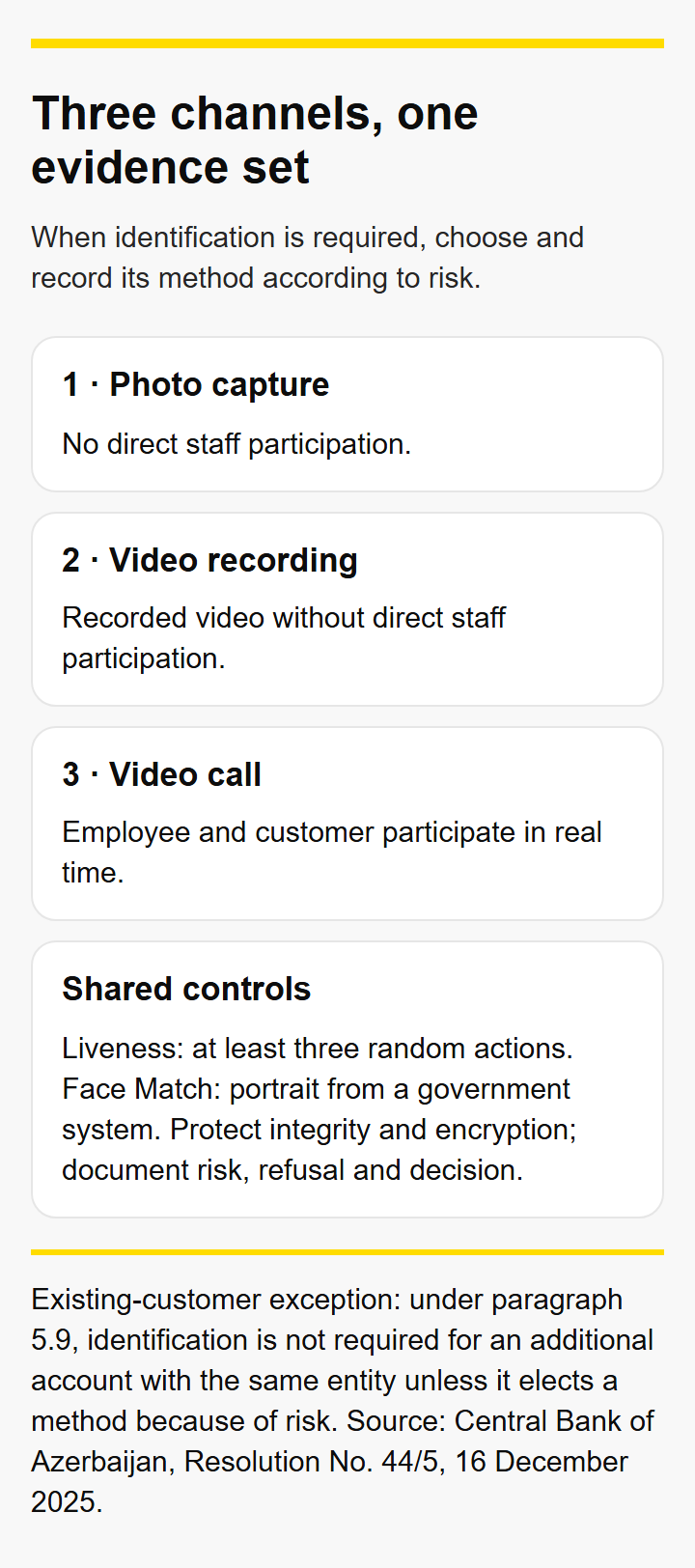
Photo capture
The customer identifies themselves without an employee’s direct participation, and the system keeps photographic material. This is not an arbitrary file upload: the rules describe capturing an image through the organization’s technical system and set common requirements for image quality, facial visibility, and absence of help from third parties.
Video recording
There is again no direct employee participation, but the process is recorded on video. Unlike an ordinary video file, the organization controls the capture route, transmission integrity, and link to a particular session. Movement in a frame alone does not satisfy the software liveness check of paragraph 5.7.
Video call
The customer and employee participate simultaneously in a live, uninterrupted call that is recorded. General bank-account rules also address staff training, KYC questions, document checks, social-engineering signs, and ending the call with confirmation of the customer’s intent.
Keep the method as its own data field. video=true conceals whether the event was an asynchronous recording or a conversation with an employee, and which rules applied.
Liveness: legal requirement and technical boundary
Paragraph 5.7 requires software to verify live presence during identification. The person performs at least three actions chosen in a random sequence. The software compares the actions with its instructions and examines live facial dynamics, including natural physiological reactions that a person cannot consciously control.
This describes an active scenario. A vendor cannot replace it with passive analysis of a single frame without a documented basis for compliance. A test program should include at least:
replay of a prerecorded session;
a photograph and screen showing video;
substitution or omission of one random action;
delay, desynchronization, and poor light;
a mask or synthetic face alteration;
help from someone outside the frame.
This is an editorial test model. The Central Bank does not prescribe this exact attack list. It translates requirements for randomness, live dynamics, quality, and absence of third-party help into reproducible tests.
Face Match uses a government portrait
Paragraph 5.8 requires software comparison of the current face with a photograph in the relevant government information system. That is stronger than comparison only with a portrait extracted from a customer-uploaded copy. Access to the source and correct integration remain the supervised organization’s responsibility.
Face Match assesses similarity at a set threshold. Liveness looks for live presentation and known attacks. Both may pass when a real customer is acting under a fraudster’s pressure. For a video call, the banking rules expressly require attention to social engineering and pressure when assessing intent.
What must happen before and after biometrics
Before identification, the organization:
receives an electronic application and the details prescribed by the regulation;
checks whether they are available from an existing file, permissible third party, or government system;
performs checks and assesses risk;
explains identification terms to the customer and obtains written consent to process personal data.
The agreement is provided on a durable medium and signed by both customer and organization with enhanced electronic signatures. When identification is required or chosen under paragraph 5.9, it must be completed as part of that route. A selfie is neither an electronic signature nor, by itself, assent to the agreement.
If identification cannot be completed, or capacity, authority, or signature checks fail, the organization refuses remote opening and explains the reason through the specified contact channel. An employee must not bypass this outcome by changing a biometric threshold.
A log that separates the rule from the model
For later review, keep:
Result | Record | Decision owner |
|---|---|---|
Data source | System, request, time, response version | KYC process owner |
Method | Photo capture, video recording, or video call | Risk rule |
Liveness | Challenges, sequence, quality, software version, result | Approved policy |
Face Match | Portrait source, score, threshold | Organization |
Session | Images, recording, encryption, integrity | Information security and compliance |
Agreement | Version, durable medium, both signatures | Authorized parties |
The regulation requires images and recordings to be obtained, transmission integrity and confidentiality protected, and process adequacy reviewed at least annually. An incident, legal change, new fraud signs, or identified weakness calls for an earlier review.
Where biometric modules stop
Biometric.Vision Liveness gives a separate live-presence result; Face Match compares the current portrait with a reference. The supervised organization must test whether the chosen configuration meets the Central Bank’s precise requirements, including the random sequence of actions.
Access to Azerbaijan’s government information systems is a separate integration managed by the supervised organization. The parties sign their banking agreement. The implementation should separately describe the official portrait source, legal ground, electronic signature, refusal rules, and retention.
Before launch, prepare a test record against paragraphs 5.5–5.10 and show it to compliance, information security, and the product owner together. They can compare each input, item of evidence, and decision with the specific rule.
Sources
Central Bank of Azerbaijan: remote account-opening regulation, Resolution No. 44/5.
Central Bank of Azerbaijan: rules on opening, maintaining and closing bank accounts.
Originally published in Russian. Adapted for English readers.
This article is for information only and does not replace advice from a qualified lawyer.
Ready to strengthen your customer checks?
500 free checks a month for a year · no card · no contract · no sales call.